


Creating a respiratory protection program
Life sciences organizations may have operations where employees could be exposed to airborne contaminants, including dusts, fumes, mists, gases, vapors or other respiratory hazards. When these hazards cannot be effectively controlled through engineering controls, employers may need to provide appropriate respirators and establish a respiratory protection program.
OSHA’s respiratory protection standard is 29 CFR 1910.134. When respiratory protection is required, employers must provide suitable respirators, medical evaluations and training at no cost to employees and implement a written respiratory protection program.
Use the information below as a guide in creating a respiratory protection program.
Respiratory protection program overview
- What's included in a respiratory protection program
Respiratory protection programs should be administered by a trained program administrator and include worksite-specific procedures for:
- Medical evaluations
- Selecting respirators
- Fit testing
- Employee training
- Proper use of respirators in routine and reasonably foreseeable emergency situations
- Cleaning, disinfecting, storing, inspecting, repairing, discarding, and maintaining respirators
- Ensuring adequate air quality, quantity, flow of breathing air for atmosphere supplying respirators
- Regular evaluation of the program’s effectiveness
- Recordkeeping
- Medical evaluations
The purpose of the medical evaluation is to determine the employee’s ability to use a respirator. The evaluation should be completed before an employee is required to use a respirator and before fit testing. The employer is responsible for identifying a physician or other licensed health care professional to perform the medical evaluation. A written recommendation should be obtained that states whether the employee is able to use the respirator and identifies any limitations regarding respirator use. If the evaluation indicates follow-up is needed, the employer shall ensure a follow-up medical examination is completed.
- Selecting respirators
Employers should estimate the employee exposure to the respiratory hazards and identify the contaminant’s chemical state and physical form (gas, vapor, particulate, etc.). Industrial hygiene air sampling can be completed to estimate employee exposure. Once the air concentration is determined, the following equation and Table 1 in OSHA’s Respiratory Protection standard can be used to select a type of respirator. Additional notes relating to Table 1, and the table itself can be found in OSHA Standard 1910.134.
MUC= APF x OEL
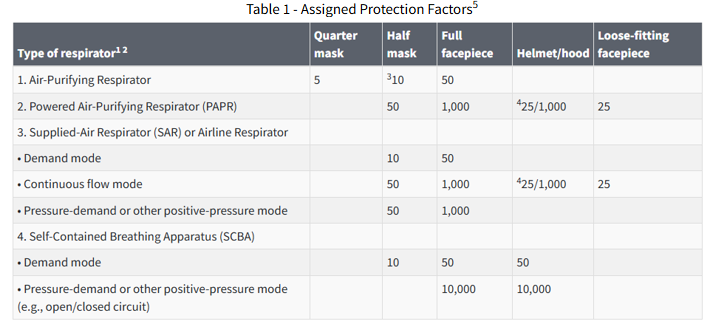
Maximum use concentration (MUC) is the maximum air concentration of a chemical that a specific respirator is expected to protect a worker from. In other words, given the assigned protection factor (APF) for the selected respirator, and the occupational exposure limit (OEL) for the chemical of concern you can find the MUC that the respirator is expected to be protective in. For example, if the chemical of concern is benzene, and employees are wearing half mask air-purifying respirators with organic vapor cartridges, then the APF for this respirator (10), would be multiplied by the OEL, the OSHA PEL for benzene is 1 ppm. Therefore, the MUC would be 10. If industrial hygiene sampling was completed and the air concentration was found to be equal to or greater than the MUC, then a more protective respirator with a higher APF, like a full face piece elastomeric respirator, or a loose-fitting PAPR, would need to be used. Because some of OSHA’s PELs are outdated, safety professionals may opt for using ACGIH’s TLVs or NIOSH’s RELs for the OEL portion of this equation. Another option is to utilize a percentage of the OSHA PEL in the OEL part of the equation. Using the same example as above, 50% of 1 ppm is 0.5 ppm multiplied by an APF of 10, makes the MUC 5 ppm.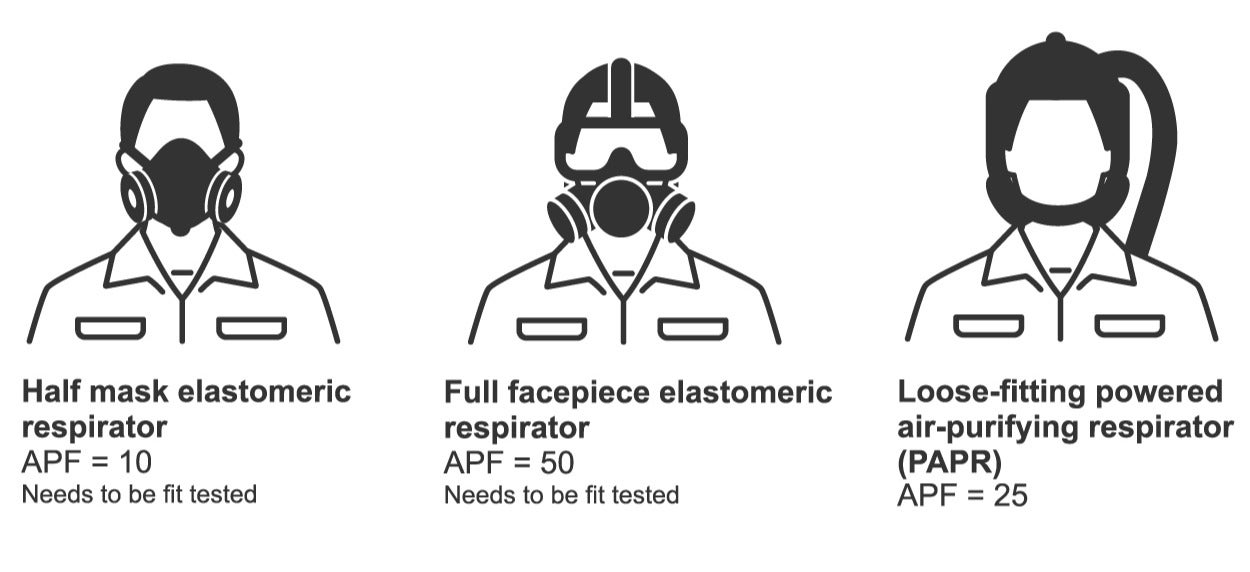
- Fit testing
The goal of fit testing is to ensure that any negative or positive pressure tight fitting respirator provides the employee with the expected protection, and is comfortable to wear. Fit tests should be completed anytime a different respirator facepiece is used, if the employee’s physical condition changes and could impact the respirator's effectiveness, and at least annually. The respirator used in the fit test should be the same make, model, style, and size that the employee will use for work. The fit test can be a qualitative fit test (QLFT) or quantitative fit test (QNFT) as long as the protocol is accepted by OSHA. A record of the test must be maintained until the next fit test is administered. Fit checks or seal checks are not the same as fit testing. Seal checks should be completed every time a tight-fitting respirator is used. Procedures for seal checks can be found here: User Seal Check Procedures
- Employee training
Training must be provided to employees that are required to wear respirators, before they are required to wear them, annually thereafter and as needed. Training should be comprehensive, understandable to the employees and cover the following topics:
- How improper fit, use or maintenance can compromise the protective effect of the respirator
- Limitations/ capabilities of respirators
- How to use the respirator effectively in emergency situations
- How to inspect, maintain and store the respirator
- Why a respirator is required
- How to put on, remove, use and check seal of the respirator
- How to recognize medical signs or symptoms that may limit or prevent effective respirator
Employees should be able to demonstrate knowledge of the items discussed during the training.
- Respirator inspection, cleaning, storage and repairs
Respirators should be inspected for tightness of connections and the condition of the face piece, head straps, valves, connecting tube and cartridges, canisters and filters. Respirator function should also be checked, along with elastomeric parts for pliability and signs of deterioration. Inspections can be completed before each use and during cleaning. Cleaning should occur as needed to maintain the respirator in a sanitary condition. If multiple employees use the same respirator, then it should be cleaned and disinfected after each use. If a respirator fails inspection, it should be removed from service and either discarded or repaired according to the manufacturer's recommendations. Respirators should be stored in a manner that prevents deformation of the face piece and exhalation value and protects the respirator from damage, contamination, dust, sunlight, extreme temperatures, excessive moisture, and chemicals.
Helpful links
Creating a respiratory protection program
Life sciences organizations may have operations where employees could be exposed to airborne contaminants, including dusts, fumes, mists, gases, vapors or other respiratory hazards. When these hazards cannot be effectively controlled through engineering controls, employers may need to provide appropriate respirators and establish a respiratory protection program.
OSHA’s respiratory protection standard is 29 CFR 1910.134. When respiratory protection is required, employers must provide suitable respirators, medical evaluations and training at no cost to employees and implement a written respiratory protection program.
Use the information below as a guide in creating a respiratory protection program.
Respiratory protection program overview
- What's included in a respiratory protection program
Respiratory protection programs should be administered by a trained program administrator and include worksite-specific procedures for:
- Medical evaluations
- Selecting respirators
- Fit testing
- Employee training
- Proper use of respirators in routine and reasonably foreseeable emergency situations
- Cleaning, disinfecting, storing, inspecting, repairing, discarding, and maintaining respirators
- Ensuring adequate air quality, quantity, flow of breathing air for atmosphere supplying respirators
- Regular evaluation of the program’s effectiveness
- Recordkeeping
- Medical evaluations
The purpose of the medical evaluation is to determine the employee’s ability to use a respirator. The evaluation should be completed before an employee is required to use a respirator and before fit testing. The employer is responsible for identifying a physician or other licensed health care professional to perform the medical evaluation. A written recommendation should be obtained that states whether the employee is able to use the respirator and identifies any limitations regarding respirator use. If the evaluation indicates follow-up is needed, the employer shall ensure a follow-up medical examination is completed.
- Selecting respirators
Employers should estimate the employee exposure to the respiratory hazards and identify the contaminant’s chemical state and physical form (gas, vapor, particulate, etc.). Industrial hygiene air sampling can be completed to estimate employee exposure. Once the air concentration is determined, the following equation and Table 1 in OSHA’s Respiratory Protection standard can be used to select a type of respirator. Additional notes relating to Table 1, and the table itself can be found in OSHA Standard 1910.134.
MUC= APF x OEL
Maximum use concentration (MUC) is the maximum air concentration of a chemical that a specific respirator is expected to protect a worker from. In other words, given the assigned protection factor (APF) for the selected respirator, and the occupational exposure limit (OEL) for the chemical of concern you can find the MUC that the respirator is expected to be protective in. For example, if the chemical of concern is benzene, and employees are wearing half mask air-purifying respirators with organic vapor cartridges, then the APF for this respirator (10), would be multiplied by the OEL, the OSHA PEL for benzene is 1 ppm. Therefore, the MUC would be 10. If industrial hygiene sampling was completed and the air concentration was found to be equal to or greater than the MUC, then a more protective respirator with a higher APF, like a full face piece elastomeric respirator, or a loose-fitting PAPR, would need to be used. Because some of OSHA’s PELs are outdated, safety professionals may opt for using ACGIH’s TLVs or NIOSH’s RELs for the OEL portion of this equation. Another option is to utilize a percentage of the OSHA PEL in the OEL part of the equation. Using the same example as above, 50% of 1 ppm is 0.5 ppm multiplied by an APF of 10, makes the MUC 5 ppm.
- Fit testing
The goal of fit testing is to ensure that any negative or positive pressure tight fitting respirator provides the employee with the expected protection, and is comfortable to wear. Fit tests should be completed anytime a different respirator facepiece is used, if the employee’s physical condition changes and could impact the respirator's effectiveness, and at least annually. The respirator used in the fit test should be the same make, model, style, and size that the employee will use for work. The fit test can be a qualitative fit test (QLFT) or quantitative fit test (QNFT) as long as the protocol is accepted by OSHA. A record of the test must be maintained until the next fit test is administered. Fit checks or seal checks are not the same as fit testing. Seal checks should be completed every time a tight-fitting respirator is used. Procedures for seal checks can be found here: User Seal Check Procedures
- Employee training
Training must be provided to employees that are required to wear respirators, before they are required to wear them, annually thereafter and as needed. Training should be comprehensive, understandable to the employees and cover the following topics:
- How improper fit, use or maintenance can compromise the protective effect of the respirator
- Limitations/ capabilities of respirators
- How to use the respirator effectively in emergency situations
- How to inspect, maintain and store the respirator
- Why a respirator is required
- How to put on, remove, use and check seal of the respirator
- How to recognize medical signs or symptoms that may limit or prevent effective respirator
Employees should be able to demonstrate knowledge of the items discussed during the training.
- Respirator inspection, cleaning, storage and repairs
Respirators should be inspected for tightness of connections and the condition of the face piece, head straps, valves, connecting tube and cartridges, canisters and filters. Respirator function should also be checked, along with elastomeric parts for pliability and signs of deterioration. Inspections can be completed before each use and during cleaning. Cleaning should occur as needed to maintain the respirator in a sanitary condition. If multiple employees use the same respirator, then it should be cleaned and disinfected after each use. If a respirator fails inspection, it should be removed from service and either discarded or repaired according to the manufacturer's recommendations. Respirators should be stored in a manner that prevents deformation of the face piece and exhalation value and protects the respirator from damage, contamination, dust, sunlight, extreme temperatures, excessive moisture, and chemicals.
Helpful links