
Article

Navigating generative AI

Generative Artificial Intelligence (Gen AI) is a form of artificial intelligence capable of writing, drawing, composing music and designing products-all driven by user prompts. 

Tools such as ChatGPT, Microsoft Copilot and Google Gemini are gaining popularity and are being adopted across various industries and businesses.


How Gen AI works
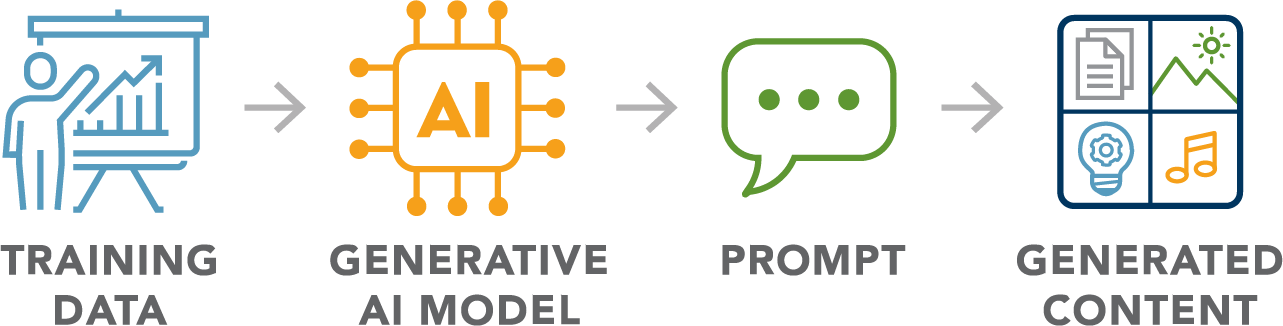
How Gen AI works flow chart


Large datasets are used to feed and train the model, allowing Gen AI to learn patterns and relationships. The prompt serves as your instruction or question. Subsequently, Gen AI produces text, images, music or designs—delivering content for the answer you requested.


How is Gen AI used in the workplace?

Today, Gen AI is becoming increasingly useful, and it’s transforming industries. 


Healthcare

Personalized treatments and drug discovery

Finance

Market predictions and fraud detection

Manufacturing

Quality control, predictive maintenance, and design optimization


Any business that manages data can gain advantages from Gen AI. It streamlines processes, increases productivity and fosters innovation. With many breakthroughs already achieved in Gen AI technology, more advancements are expected soon. 

However, while Gen AI offers impressive capabilities, it is important to recognize potential concerns and risks.


Understanding the risks

Gen AI is impressive, but not flawless. There can be risks that need to be considered, such as:


Unreliable content

Gen AI can “hallucinate” facts or cite fake or outdated sources. Gen AI doesn’t know facts. It makes predictions based on patterns in its training data, so it cannot verify what it says.

Bias and discrimination

It may reinforce stereotypes or skew results. This can stem from learning biased patterns from its training data.

Privacy and security

Deepfakes, voice scams and phishing are real threats that are becoming more sophisticated and difficult to identify their authenticity. All forms of AI are data-driven and may be used by “bad actors” for misuse.


Ultimately, these risks will impact Gen AI users, and if not addressed, could infiltrate everyday tools and shape people's thoughts. 


Regulatory landscape

As of 2025, the United States still lacks a comprehensive federal law covering all aspects of AI. The latest indications suggest that Federal regulations, if any, will prioritize innovation over excessive rules. 

However, at the state level, it's a different story. Some states have enacted AI-related laws, many of which focus on data privacy, transparency and bias prevention. Although there isn't a single global AI law yet, numerous countries are working toward one. The European Union is leading with the EU AI Act, the world’s first comprehensive AI regulation that categorizes AI systems by risk and sets different requirements for each. 

Although AI legislation is advancing, it’s likely to lag behind the pace of AI technology itself. Whether you’re developing, using, or simply interested in AI, staying informed is essential.


Mitigating AI risks

Security and privacy

Security and privacy are vital, and the most up-to-date and relevant safety measures must be in place for organizations using Gen AI in their workplaces.

  • Encrypt everything – data in storage and in transit.
  • Limit access – only authorized people should have allowances and access to certain data.
  • Consider an Enterprise Data Protection (EDP) contract with Gen AI tools as an option, such as Microsoft Copilot. An EDP helps protect your company’s data, keeps it private, and prevents it from being used to train AI foundation models.

To help navigate Gen AI risks, tools like the AI Risk Management Framework for Gen AI from the National Institute of Standards and Technology (NIST AI 600-1) can serve as a playbook for managing Gen AI risk.

Lastly, to successfully navigate the risks of using Gen AI in your organization, ensure full transparency and accountability, and make sure all outputs from any Gen AI tool are verified for accuracy and correctness.


Governance

To mitigate the occurrence of unreliable content, biased and discriminatory practices, and to ensure data privacy and security, organizations need solid governance. 

Some best practices to consider:

  • Stay updated: Make sure to be vigilant about relevant AI laws and compliance
  • Verify outputs: Be aware that Gen AI tools have limitations, so do your due diligence
  • Train employees properly: Teach those in your organization about the ethical, safe use of AI, including company policies.


Gen AI should not be used for:

  • Handling private or sensitive information.
  • Making final legal, financial or medical decisions.
  • Reviewing official policy or contracts – it might miss some legal nuances or introduce the wrong context.
  • Performing employee background checks, which may result in unfair or discriminatory outcomes.
  • Determining compliance or regulatory requirements may misinterpret the context, provide outdated information or include other inaccuracies.


Summary

Gen AI is rapidly transforming workplaces and beyond, offering efficiency, creativity and convenience. However, it carries risks throughout its lifecycle—from training to deployment. While federal regulations lag, organizations should consider managing these risks through diligence, adequate risk management controls and ongoing monitoring.

When navigated responsibly, Gen AI can be a significant positive game-changer.


Sources

National Cyber Security Centre

National Institute of Standards and Technology-1

National Institute of Standards and Technology-2

Federal Register

U.S. Department of Commerce

Article

Navigating cyber threats and extortion in an evolving landscape

An article in our Plugged In tech and life sciences series

By Mitchell Foster II, Chief Underwriting Officer for Technology and Life Sciences

Technology companies are one of the most attractive targets for cyber criminals as they have access to large amounts of data, including personal information, intellectual property and financial records. As the backbone to many other businesses, tech companies face significant risk from cybercrime, making it critical they safeguard their systems and manage their data appropriately. 

As a result, many are shifting their focus from reactive crisis plans to proactive, preventative measures. Fortunately, independent insurance agents can help their tech clients protect their businesses through risk prevention, mitigation and effective insurance programs. 
 

The evolution of cyber threats

Cyberattackers are becoming increasingly sophisticated, often using artificial intelligence to be more efficient. A report from Statista suggests 45-50% of phishing emails sent to businesses could be AI-generated by the end of 2025, potentially increasing victim response rates to 62-65%. 

Beyond the direct operational and financial impact, a cyber incident can damage a company’s reputation. As a result, customers and partners are requiring even more rigorous due diligence from their tech partners, both from a cybersecurity and a business continuity perspective. Customers and partners can quickly lose trust if a brand’s image is damaged, and some tech companies may never fully recover from the reputational fallout, making it even more important plans are in place to help minimize the long-term reputational impact.  


Risk prevention is key

As tech companies look to grow, sound risk management and robust business continuity operations are essential. These companies seek partners that can help expertly manage their systems, protect their data and recognize their tech partners’ cybersecurity is just as important as the technology offerings they provide. 
 

Companies that fare best against cyberattacks understand how their systems are backed up. 

  • Are they air-gapped and totally separate?
  • Are they complete backups?
  • Are they performed at a regular cadence? 

A current and complete backup can make all the difference in restoring systems after an extortion event, helping to minimize the impact to business income while the experts handle the incident. 


The role of the independent agent

Agents looking to best support their tech clients should consider partnering with carriers that offer the following:

  • Risk mitigation services – Programs that offer proactive risk management services, such as cybersecurity reviews, dark web monitoring, phishing attempt tracking and multi-factor authentication support can help protect tech businesses.
  • Public relations coverage – PR or crisis firms can provide critical assistance with executing a campaign to help restore brand image.
  • Unified tech and cyber offerings – Combined errors and omissions and cyber coverage offerings in one product offer a seamless solution that can help companies avoid potential gaps or delays in responding to attacks.

If a tech business suspects a cyberattack or is experiencing a cyber extortion incident, having direct contact with a claims expert is also imperative in helping to manage the crisis and minimize impact.

The vulnerability of tech companies to cyberattacks underscores the need for comprehensive data management and robust cybersecurity measures. By partnering with independent insurance agents, tech companies can not only help minimize these risks but also ensure they have effective insurance programs in place to protect their businesses. 


Let's start a conversation today

Contact a member of our technology or life sciences teams to learn more about our coverage and services, and how we can help you tailor a solution for you and your clients.


Headshot of The Hanover's Mitchell Foster
Mitchell Foster II, Chief Underwriting Officer for Technology and Life Sciences

About the author

Mitch has more than 20 years of experience in the insurance industry, specializing in technology and life sciences over the past decade. He has held various underwriting leadership roles throughout his career. In his current role, Mitch is responsible for The Hanover's national strategy and appetite for technology and life sciences.

Article

The growing use and emerging risks of exoskeleton technology

An article in our Plugged In tech and life sciences series

By Mitchell Foster II, Chief Underwriting Officer for Technology and Life Sciences

Exoskeleton technology – wearable devices that enhance physical capabilities and reduce strain – is expanding rapidly beyond its initial niche applications. Due to this recent demand, one report projects the global exoskeleton market to almost triple in value – to $1.25 billion – by 2030.*

Yet as adoption accelerates, so do the associated risks. For insurance agents, this represents a strategic opportunity, as organizations across technology and life sciences turn to agents to understand their evolving exposures and ensure they have coverage tailored to their high-growth, innovative operations.
 

Leveraging technology to reduce injury risk

Manufacturing, logistics and construction businesses have started using exoskeleton technology to reduce repetitive motion injuries and improve worker ergonomics. These devices are often used in environments where physical demands and injury rates are often high.

Beyond physical support, exoskeletons are seeing increased use as diagnostic tools. With embedded sensors and AI, they can monitor movement patterns to detect early signs of strain or injury and reduce workplace injuries through proactive intervention.

While the potential for reducing workers’ compensation claims is considerable, so too is the risk of malfunctions, improper calibration or software errors which can result in physical harm, triggering liability claims. Additionally, the use of monitoring data introduces privacy and ethical considerations that need to be addressed as adoption expands.
 

Elevated patient care – and privacy concerns

In healthcare settings, exoskeletons are used to support rehabilitation, reduce caregiver fatigue and restore a measure of independence to individuals with limited mobility. This includes devices used to assist patients with neuromuscular conditions or spinal cord injury in regaining a broader range of movement. For example, a patient with Parkinson's may use an exoskeletal arm to lift utensils and eat independently.

This usage presents risk on two fronts: mechanical failure or misuse leading to injury, as well as concerns of privacy and cyber risk related to the integration of patient data into digital healthcare systems.


Aligning coverage with exposures

One of the more nuanced challenges in insuring companies that develop exoskeleton technology lies in the end use. There may be times where a business develops the technology and it is used across different industries, making it more of a hybrid risk that crosses from technology to life sciences or even manufacturing. See the examples below:


Life sciences

A company producing an exoskeletal arm to aid patients with mobility

Technology

A company producing that arm's support system


This distinction affects not only underwriting but also regulatory compliance and product liability exposure. This is why agents must work closely with carriers who understand the intricacies of both sectors.

For example, tech-based errors and omissions (E&O) coverage is particularly relevant for firms integrating software and hardware. A robust tech E&O policy will include:

  • Technology services liability – covering implementation errors
  • Product performance coverage – for failures resulting in injury or financial loss
  • Cyber liability – to protect against data breach and other cyber risks
  • Intellectual property protection – to guard against infringement claims

For any company manufacturing exoskeleton technology, a comprehensive insurance plan should include product liability coverage to address claims stemming from design flaws, manufacturing defects and operational failures.
 

Supporting innovation with expertise

With the broadened use of this technology, it is increasingly important to partner with a carrier like The Hanover who understands the technology and life sciences industries, and can offer specialized solutions for these companies across both of these sectors.

Agents who understand both the opportunities and the potential risks of exoskeleton technology will be best equipped to advise clients and provide coverage that meets their needs today, and as they evolve in the future. 


Let's start a conversation today

Contact a member of our technology or life sciences teams to learn more about our coverage and services, and how we can help you tailor a solution for you and your clients.


Headshot of The Hanover's Mitchell Foster
Mitchell Foster II, Chief Underwriting Officer for Technology and Life Sciences

About the author

Mitch has more than 20 years of experience in the insurance industry, specializing in technology and life sciences over the past decade. He has held various underwriting leadership roles throughout his career. In his current role, Mitch is responsible for The Hanover's national strategy and appetite for technology and life sciences.

*Source: Grand View Research

Article

What to do if you’re caught boating in a storm

It’s important to be on the lookout for bad weather before boating, but the weather can be unpredictable. In 2024 alone, bad weather was the leading cause of 224 water vessel incidents. If you find yourself on the water when a storm rolls in, quick thinking and preparation can make all the difference in returning safely.


Caught in an unexpected storm? Follow these safety tips.

  1. Don’t ignore the lightning – As soon as you see lightning strike, stop any activities.
  2. Put on your life jackets – Ensure everyone on board is wearing a properly fitted life jacket.
  3. Secure loose items – Storing extra items onboard helps lower the chance of passenger injuries.
  4. Disconnect electronics – Disconnecting any extra power sources can help prevent surges from the storm.
  5. Close the windows – It may not be the first thing on your mind when a storm comes in, but it is a crucial step to avoid a flooded cabin which can weigh down the boat.
  6. Steer in a 45-degree angle – Finally, when you think you can make it to shore, going at a 45-degree angle can help to get you there as safely as possible.  


Stay prepared, stay protected. 

Talk to your insurance agent to make sure your watercraft coverage is up to date, or learn more about our boat insurance options.
 

Sources:
Inland Boating Tips 
2024 Recreational Boating Statistics 
Boat in a Storm | 6 Tips for When Your Boat's in Rough Seas - Jet Dock

Article

AI adoption: Top risks for tech businesses

An article in our Plugged In tech and life sciences series

By Mitchell Foster II, Chief Underwriting Officer for Technology and Life Sciences

In a very short time, artificial intelligence has gone from being a futuristic concept to a force reshaping how businesses operate across nearly every industry. One survey reports that 78% of organizations now report using AI in at least one business function — up from 55% just a year earlier.*

For insurance agents, this highlights the need to stay informed on AI trends, and how their clients implement AI in their own operations. The agents who grasp the nuances and unique exposures tech companies in different segments face will be best positioned to help their clients navigate these evolving risks. 


Info tech: Automation with new risks

In the information technology sector, developers increasingly rely on AI-powered tools to generate code, identify bugs, and produce technical manuals. Generative AI has also seen increasingly wide use in research, education, programming and content production. 


The benefits

  • Streamlined development
  • The ability to personalize content delivery

The risks

  • Concerns around data privacy, intellectual property rights and algorithmic bias
  • Increased potential for errors as these tools become more embedded in daily operations


Electronics manufacturing: Enhanced precision, new vulnerabilities

Manufacturers are integrating AI into production lines to control temperature and timing and manage inventory. Plus, with the ability to identify microscopic flaws that a human inspector might miss, AI is being used to inspect circuit boards, solder joints and other components for defects.  


The benefits

  • Improved quality control
  • Greater operational efficiency

The risks

  • Concerns about data integrity and security
  • Potential displacement of human workers, raising operational and reputational concerns 


Telecom: Smarter networks, higher stakes

Telecommunications providers are using AI to allocate bandwidth, predict network congestion and automate fault resolution. AI-powered chatbots often handle routine inquiries in customer service, while cybersecurity systems monitor for signs of malicious activity.


The benefits

  • Improved service quality
  • Reduced costs
  • Reduced downtimes

The risks

  • AI models can be manipulated by bad actors
  • Unauthorized access can compromise customer data
  • System outages due to insufficient human oversight


Building a proactive risk management strategy

For tech companies in all segments, a reliance on AI demands a robust risk management framework. Agents can deliver value to their tech clients by encouraging a structured approach to risk, with a focus on five key areas:

  1. Data management - Organizations should implement encryption, access controls and bias mitigation strategies to ensure the integrity and fairness of AI systems.
  2. Cybersecurity - Regular vulnerability testing and investment in advanced threat detection are essential to protect AI infrastructure from external attacks, including data spoilage.
  3. Compliance and legal oversight - Maintaining audit trails and ensuring adherence to industry regulations will help clients avoid legal exposure as AI use expands.
  4. Continuous monitoring - AI systems should not operate in isolation. Human oversight is necessary to validate outputs and intervene when anomalies occur.
  5. Employee training - Staff must be educated on the capabilities, limitations and necessary safeguards of AI tools to ensure appropriate usage.  


Coverage that evolves with technology

In addition to proactive risk management, clients should maintain a professional and cyber liability policy that includes a broad definition of their services and deliverables. This ensures that, as AI evolves, their coverage remains robust and relevant.

By partnering with a carrier such as The Hanover, agents can provide access to both tailored coverage and actionable risk management strategies—helping clients proceed with confidence in an era of rapid technological change.


Let's start a conversation today

Contact a member of our technology or life sciences teams to learn more about our coverage and services, and how we can help you tailor a solution for you and your clients.


Headshot of The Hanover's Mitchell Foster
Mitchell Foster II, Chief Underwriting Officer for Technology and Life Sciences

About the author

Mitch has more than 20 years of experience in the insurance industry, specializing in technology and life sciences over the past decade. He has held various underwriting leadership roles throughout his career. In his current role, Mitch is responsible for The Hanover's national strategy and appetite for technology and life sciences.

*Source: McKinsey's 2024 Global Survey on AI

Article

Safeguarding the research of life sciences organizations

An article in our Plugged In tech and life sciences series

By Toni Mitchell, President of Technology and Life Sciences

In the development of new medical treatments, drugs, and procedures, life sciences organizations may rely on research animals to meet the FDA approval requirements. These animals play a vital role in the development of these new drugs and procedures—but with this critical work comes a unique set of risks.
 

Understanding the risk landscape

This research work is subject to strict and specific requirements from the FDA, USDA and other regulatory agencies to ensure the ethical treatment of these animals and the scientific integrity of the research. Additionally, with each animal can come a level of investment of time and resources that can exacerbate the impact of a loss if not properly protected.

Therefore, it is crucial that these organizations that conduct animal research secure insurance coverage with a carrier that understands and can properly valuate the work they do. A proactive risk management strategy is the first step in safeguarding both the animals and the research they support.
 

Establishing a foundation for protection

Proactive risk management is an essential component to safeguarding animals and research. Life sciences organizations working in this space should implement thorough processes, including:

  • An emergency response plan to handle any event requiring evacuation or relocation of the animals. This plan should include controls to ensure proper handling, prevent animal escape, and identify back-up facilities where they will continue to operate. Having response procedures in place if an animal does escape from a facility is also a key part of this plan.  
  • Monitoring systems, such as those available through the Hanover I-on Sensor Program™, to assure that temperature, humidity and lighting are adequately maintained around the clock for the overall well-being of the animals and the integrity of the research.
  • An Institutional Animal Care and Use Committee (IACUC) to review and oversee protocols for the use of research animals and ensure compliance with all regulatory standards for the appropriate housing, handling, feeding and care of these animals.
  • Security and access control, including secure entry systems and surveillance to prevent unauthorized access.
     

Aligning coverage with valuation

When determining coverage limits for an organization that conducts animal research, there are two unique facets to consider:

  • Replacement cost: How much does it cost for an animal of comparable kind or quality?
  • Value change: How does the time and money already invested in research effect the animals’ worth?

Replacement costs can vary significantly and extend beyond just the animal's initial cost. That’s why organizations conducting this research must factor in the value of completed research, duration of animal use, and availability and cost of new animals. These factors are often overlooked when insured value is being determined.

Consider this example: 


$100K

A research facility experienced a fire at their animal testing facility, resulting in the loss of 50 genetically modified mice. The replacement cost for each mouse was approximately $2,000, and if this was the only value considered in the facility’s insurance policy, the claim would’ve amounted to $100,000. 

or

$2.6M?

However, the research investment into each mouse was estimated at $50,000. Because the facility had coverage that included the value of their research investment, the carrier compensated $2,600,000 for the claim - $100,000 for the replacement of the animals and an additional $2,500,000 for the research investments made.


This example highlights the importance of working with a carrier who understands the unique risks life sciences organizations face and can offer consultation on the proper valuation that includes consideration of research and milestones to offer proper limits.


The value of industry expertise

When working with life sciences organizations, look for a carrier that offers coverage solutions specifically designed to address the risks associated with the use of research animals. A carrier like The Hanover, with deep expertise in life sciences, can provide the targeted coverage and risk management services these organizations need to successfully conduct their work safely. 
 

Let's start a conversation today

Contact a member of our technology or life sciences teams to learn more about our coverage and services, and how we can help you tailor a solution for you and your clients.


Headshot of The Hanover's Toni Mitchell, President of Technology and Life Sciences
Toni Mitchell, President of Technology and Life Sciences

About the author

Toni joined The Hanover in 2010 after previously holding leadership roles at One Beacon and Atlantic Mutual. As a regional executive for the Pacific Region, Toni led enterprise-wide strategies and new business development across The Hanover’s core and specialty units. In her current role, Toni delivers tailored solutions for The Hanover's technology and life sciences clients, through deep technical expertise and strong distribution partnerships.

Article

What is a wind-rated garage door?

When it comes to storm safety, most homeowners think about fortifying their windows or roof. But many homes have an even larger, and lesser known, vulnerability: their garage door.

A garage door often acts as an entry point for damage during a high-wind event. When they fail, the consequences can be catastrophic, including roof loss, wall collapse and extensive interior damage.

A wind-rated garage door is made using materials and components designed to withstand the intense pressures of high winds and flying debris associated with hurricanes and tornadoes.
 

Why do I need a wind-rated garage door?

Your garage door covers a large opening—often the largest in your home. If it fails during a storm, wind can rush inside, pressurizing the interior and lifting the roof off like a lid. According to the Insurance Institute for Business & Home Safety (IBHS), homes with intact garage doors are significantly less likely to suffer major structural damage.
 

How do I know if my garage door is wind-rated?

Check for the wind-rating label. If it’s missing or unreadable, your door may not be rated—or may be too old to meet current standards.

A proper label should include:

  • Manufacturer and model number
  • Design pressure rating (e.g., +40/-40 psf)
  • Wind speed rating and exposure category
  • Compliance with ANSI/DASMA 108 or similar standards
     

Do all areas require wind-rated garage doors?

Not necessarily. Homes in coastal and high-wind zones are more likely to need a wind-rated garage door. 

Additionally, each door is assigned a design pressure rating, which can vary based on your home’s location and exposure. For instance, urban areas (Exposure B) face different risks than open zones (Exposure C).

To learn if your current garage door is suitable for your wind zone, refer to FEMA's wind zone map or contact your local building inspector to determine your area’s wind speed requirements.
 

What do I do if I need a wind-rated garage door?

Choose a door that meets or exceeds your local code. Ensure it’s installed with the correct tracks, struts and fasteners. Consider doors that meet IBHS’s FORTIFIED Home™ standards for added protection and potential insurance benefits.
 

Are wind-rated garage doors more expensive?

When storms strike, your garage door could be the difference between minor damage and total devastation.

A wind-rated garage door can cost more upfront, but they may save you tens of thousands in storm damage—and could even qualify you for insurance discounts. 
 

Can I retrofit my existing garage door?

Yes. Reinforcement kits are available, but they may not offer the same protection as a fully rated door. In many cases, replacement is the safer and more reliable option.


Don’t wait for the next weather event

Wind-rated garage doors are more than a building code requirement—they’re a critical investment in your home’s safety.

Act today: inspect your garage door, understand your wind zone, and consult a certified installer if you’re unsure. And if you make updates to your garage door, notify your independent insurance agent, as you maybe be eligible for a safety discount on your home insurance policy.

Article

Preventing professional liability claims

Professional liability insurance, also known as errors & omissions (E&O) coverage, provides protection for defense costs and settlement payments for claims that your company’s work or advice was inadequate, contained errors or failed to meet specifications. These claims can cause your company to sustain significant financial and reputational losses.

Whether it is a service delay, overlooked details, employee mistake, disagreement over payment, disputed advice or a client complaint, it could lead to legal action against your company. Here are eight tips to help mitigate these events and protect your business from financial and reputational losses.


8 tips to mitigate professional liability claims

  1. Use detailed contractual agreements

    It is essential to ensure detailed contractual agreements are in place before the start of the service work. A detailed contract is critical and will protect your company's interests in disputes or claims. Maintaining comprehensive records of all transactions is also essential as proof that your company met the terms and conditions outlined in the contract. 

  2. Communicate effectively with clients

    Effective communication helps clients understand the services or products they receive, prevents any issues, and resolves problems. Regular updates, transparency about delays, honesty, empathy and professionalism are key to maintaining strong client relationships, even in stressful situations.

  3. Properly screen employees and vendors

    Properly screen employees, vet third-party vendors through background checks and thorough interviews and ensure they are insured, licensed, experienced and well-trained. Maintaining their satisfaction fosters reliable performance, loyalty and positive relationships.

  4. Implement standard operating procedures, training and auditing

    Preventing false claims and misleading information is vital for trust and compliance. Educate employees on the internal code of ethics/conduct, E&O exposures and best practices. Conduct regular self-audits and establish a planned review process to catch mistakes early or at certain milestones during the project. This can include quality management practices, checklists, peer reviews, etc.

  5. Maintain regulatory and industry compliance 

    Stay updated on licensing, regulations and industry best practices to avoid mistakes and provide accurate advice. This ongoing education helps deliver better services and ensures compliance with laws.

  6. Avoid providing service or advice outside your area of expertise

    Offering services or advice that falls outside the boundaries of your professional services and contractual obligations can lead to complications. Whether it involves providing guidance or control in a manufacturing process, installation or repair service, construction project or training, never offer advice or deliver services your company is not qualified to perform.

  7. Maintain cybersecurity program

    Maintaining strong IT security and regularly updating your systems is crucial to protect against breaches and failures. This ensures operational integrity, safeguards confidential information and prevents work loss or compromise due to cyberattacks.

  8. Effective documentation

    Maintaining detailed records of all transactions and communications is essential for defending your company's dispute position. This includes documenting all client interactions, following up meetings with emails and keeping accurate records of contracts, communications and invoices with digital backups.


Reduce your risk

Having adequate professional liability or E&O coverage to protect your company in case of a client claim or lawsuit is essential to preventing financial losses. It’s also vital to prevent these claims from happening in the first place to mitigate reputational losses. By following these tips, your business can significantly reduce the risk of professional liability or E&O claims. 

For more information on professional liability insurance, please review our additional resources.

Learn more

Article

The complex dangers of spoilage for life sciences organizations

An article in our Plugged In tech and life sciences series

By Toni Mitchell, President of Technology and Life Sciences

Life sciences organizations handle materials and develop products in environments that are heavily regulated and climate controlled. This makes them uniquely vulnerable to costly and damaging claims in the event of spoilage and contamination. Agents can play a crucial role in helping these organizations navigate these risks and ensure their operations are properly prepared and protected.
 

Four key vulnerabilities

Being aware and knowledgeable about the unique considerations life sciences organizations face is key to providing risk management counsel and offering the right coverage solutions for your customers. Areas of risk related to spoilage for life sciences organizations include:
 

  1. Cold-chain vulnerability: Many life sciences products, such as pharmaceuticals and biologics, require strict temperature control to maintain efficacy and safety. Any change in temperature could result in these products being prohibited from distribution.
     
  2. Contamination prevention: Bacteria, viruses, or other pathogens can spoil products, especially in the production of biologics and other sensitive materials. Sterile environments and validated cleaning protocols are essential to prevent microbial contamination.
     
  3. Proper handling: Mishandling during transportation, storage, or within the production facility can lead to spoilage. This includes physical damage or exposure to unsuitable conditions. Incorrect labeling, improper storage, or failure to follow protocols can all result in spoilage.
     
  4. Regulatory compliance: Organizations must adhere to strict guidelines to ensure proper handling, storage, and transport. Failure to adhere to regulatory standards and guidelines results in the product being compromised and no longer viable for use.


Consequences of spoilage

The scope of a spoilage event can quickly exceed the impact to the product itself. Beyond financial loss due to wasted material, there are also costs associated with disposal, replacement of products, and often the need to reproduce the products. Spoilage can lead to operational disruptions, regulatory consequences and costly product recalls.

Consider this real example:


At least

$370K

in damages

A widespread power outage that lasted for four days resulted in a life sciences company's refrigeration equipment inability to maintain the required temperature for their product. All of the impacted products had to be thrown out, resulting in a $370,000 claim. Add to that the potential for regulatory consequences from the FDA or a potential for product recalls, and the cost could continue to climb.

 
Not all solutions are created equal

It’s important to understand the potential impact of a spoilage event and the risk prevention and coverage options that can help ensure customers are well prepared. Not all coverage is created equal, and it's important that as agents consider coverage solutions for life sciences, unique aspects of their business are considered. For example, the spoilage coverage triggers in a standard policy may not extend coverage if a human error or mistake leads to a spoilage loss.


Providing advice for proactive prevention

Agents can add more value to life sciences organizations by helping them proactively mitigate these risks. By implementing robust quality control measures, investing in reliable storage and transportation systems, and ensuring compliance with regulatory standards, organizations will be well-positioned. In addition, continuous monitoring and staff training are essential to minimize the risk of spoilage. Agents can offer insight and guidance on a risk management program including:

  • A 24-hour sensor system, like the Hanover i-on Sensor ProgramTM, to detect and monitor leaks and temperature changes
     
  • Regular maintenance of refrigeration, cooling, or humidity control equipment
     
  • Redundant refrigeration, cooling, or humidity control equipment
     
  • Business continuity plans


Partnering with the right carrier

Even with the best controls in place, mistakes happen. But those mistakes can be costly to a life sciences organization if their carrier doesn’t provide the right protection. 

That's why it's important to partner with a carrier that offers the industry knowledge, coverage, and risk management services needed to recover from spoilage and other potentially devastating threats. This includes coverage, such as all risk peril protection offered by The Hanover, that provides broader and more comprehensive safeguards created for life sciences businesses.

By understanding these risks and providing comprehensive coverage and support, agents can help life sciences organizations manage spoilage risks effectively.
 

Let's start a conversation today

Contact a member of our technology or life sciences teams to learn more about our coverage and services, and how we can help you tailor a solution for you and your clients.


Headshot of The Hanover's Toni Mitchell, President of Technology and Life Sciences
Toni Mitchell, President of Technology and Life Sciences

About the author

Toni joined The Hanover in 2010 after previously holding leadership roles at One Beacon and Atlantic Mutual. As a regional executive for the Pacific Region, Toni led enterprise-wide strategies and new business development across The Hanover’s core and specialty units. In her current role, Toni delivers tailored solutions for The Hanover's technology and life sciences clients, through deep technical expertise and strong distribution partnerships.

Article

Future-proofing tech companies against cyber threats

An article in our Plugged In tech and life sciences series

By Mitchell Foster II, Chief Underwriting Officer for Technology and Life Sciences

The tech industry faces growing challenges in safeguarding its operations and reputation. Because data breach incidents are on the rise, they are becoming less likely to make headlines, which may be giving businesses a false sense of security. However, tech companies impacted by these events can face reputational, financial and operational loss.

Four reasons tech companies are facing increased risk:
 

  • New vulnerabilities: As tech companies expand their digital presence into new arenas, such as cloud services, IoT devices and remote work setups, these new avenues present new vulnerabilities that cyber attackers can exploit.
     
  • More sophistication: Attackers are now using advanced techniques, including AI-driven malware and ransomware, making it even more challenging for businesses to prepare and defend against these threats.
     
  • Deeper integration: The services provided by tech companies are often a linchpin for many other operations. Tech customers form the foundation for an unbelievable number of businesses, making their services integral to day-to-day operations.
     
  • Wide-reaching impact: Many technologies have taken the place of humans in operational processes. If these technologies fail or are breached, even a small mistake can have an outsized impact.
     

What does this mean for tech businesses?

A single vulnerability in a tech company offering cloud services can be far more crippling to a technology company than hacking into a single retail store, given the vast amount of personal and confidential information available. For example, in 2024, one cybersecurity firm reported a 30% annual increase in attacks targeted at technology developers and service providers.*

A first-party cyber event can have a significant implication for a technology business, in several key areas:
 

  • Financial: The financial impact of a data breach to a tech company can be enormous. Plus, cybercriminals believe that tech companies are more likely to pay ransoms to quickly regain access to their data and systems.
     
  • Reputational damage: Tech is a high-profile industry, which can make a data breach from a tech company more likely a target of media coverage. This negative publicity can often erode customer trust and damage the brand, deepening the impact.
     
  • Operations disruption: When a network is breached, or is under a cyberattack, this causes service downtime for customers that rely on the tech company. When day-to-day operations are halted, this leads to decreased productivity and lost revenue.
     
  • Legal and regulatory consequences: A data breach may lead to compliance violations that result in fines for non-compliance with data protection laws and regulations.

To illustrate the risks that tech companies face, and how agents play a vital role, consider this example:
 

A managed service provider has a client base of over 5,000 businesses. This means they have a vast repository of sensitive and confidential data that requires protection. And the stakes are incredibly high, as any breach could not only compromise this data but also severely damage the tech company's reputation. The ripple effects of such an incident can be far-reaching, affecting customer trust and brand integrity.

In this scenario, it is crucial to offer coverage that can respond and enhance the data recovery process. Equally important is providing robust support to help clients manage the potential public relations fallout. This dual approach ensures that the company can maintain its operational stability and continue to thrive in the face of adversity.


Three things tech companies should do

Historically, the focus of data breach planning has been on reactive measures to respond when an attack occurs.

But now, more than ever, it is essential for tech companies to shift to proactive risk mitigation. This includes employing threat intelligence and predictive analytics to anticipate and mitigate risks before they result in a loss, including:
 

  1. Vaulted or air-gapped backup: Duplicate your data and ensure you can switch to the backup seamlessly in the case of an attack.
     
  2. Multi-factor authentication (MFA): Implement MFA to add an extra layer of security.
     
  3. Monitoring and patching cadence: Regularly monitor systems and ensure all software is patched promptly to mitigate vulnerabilities.

Additionally, partnering with a carrier like The Hanover can deliver additional value through solutions engineered for technology businesses, including preventative cyber services and proactive and responsive services if an event should occur, available through the Hanover CyberSecure Program™.

By adopting these strategies, tech companies can better protect themselves from evolving cyber risks and ensure the integrity and reliability of their services.
 

Let's start a conversation today

Contact a member of our technology or life sciences teams to learn more about our coverage and services, and how we can help you tailor a solution for you and your clients.


Headshot of The Hanover's Mitchell Foster
Mitchell Foster II, Chief Underwriting Officer for Technology and Life Sciences

About the author

Mitch has more than 20 years of experience in the insurance industry, specializing in technology and life sciences over the past decade. He has held various underwriting leadership roles throughout his career. In his current role, Mitch is responsible for The Hanover's national strategy and appetite for technology and life sciences.

*Source: Cisco Talos

Subscribe to