Article

Safety tips when considering a big truck purchase

There is a trend in pickup truck design that has led to a growing problem on the roadways.

In recent years, truck makers have pushed the envelope for bigger and more aggressive models. Compared to 2000, pickups are now 24 percent heavier and the hood height is 11 inches taller – with the largest weighing in around 7,000 pounds.

These larger pickup truck designs, however, have also meant increased safety concerns such as bigger blind spots and longer braking distances. This puts truck drivers in danger of increased likelihood for accidents with pedestrians and drivers in smaller vehicles.

When shopping for a larger pickup truck, consider some key safety tips to help minimize your chances for a dangerous accident:

Brake for AEB

As pickup trucks get bigger, the ability for them to brake becomes more difficult.

Although pickup trucks now take more effort to stop, they are less likely to come equipped with automatic emergency braking (AEB) systems than other vehicles.

Invest in a model with a quality AEB system to help yourself brake in time and reduce the chances of an accident.

Pedestrian detection tech

There is a lot more truck to look around nowadays – leaving larger blind spots for pickup truck drivers.

However, blind spot warning and pedestrian detection for the new breed of large trucks do not often come standard.

Make the choice to invest in a pickup truck with the technology to help you detect potential accidents. Any vehicle with blind spot warning and pedestrian detection technology increases your awareness of others walking or driving on the road around you.

Consider full-size truck alternatives

If smaller, compact cars are not practical enough for your lifestyle, there are options for larger vehicles without compromising safety that can perform some of the desired hauling duties of a pickup:

  • Mid-sized SUVs: good for towing up to 5,000 pounds on some models or a small boat or small camper
  • Compact vans: capable of hauling good amount of cargo and are easier to drive
  • Smaller trucks: can carry bikes, small loads and mulch

Rent instead

Maybe you’re looking to purchase a larger pickup truck as a way to haul large items now and then or help friends move.

But how often are using an oversized pickup truck to haul tens of thousands of pounds of equipment? Renting can get your big job done and reduce the amount of drives in a vehicle with growing safety concerns.

Consider renting one with higher rental limits, as full-sized trucks typically command higher fees.

Talk to your agent

If you are not sure what protection is best for your truck – no matter what size it is – talk to your independent insurance agent. Be sure to ask about higher liability limits.


Sources

Consumer Reports

Bloomberg

LC 2021-358

Article

Laying up your boat for the winter

You've worked hard all season to keep your boat in seaworthy shape. Boat maintenance, however, does not stop just because your ride around the water did.

Removing your boat and laying it up for the winter season takes thought and planning, so you can keep your vessel in quality long-term health once the favorable boating conditions return. Consider these tips for laying your boat up for a long duration:

Clean

Make sure to remove all of your boating equipment, including any seat cushions, removable electronic equipment, bed linens, lines, etc.

If you are hauling out the boat yourself, get a jump on boat prep for next year by waxing and scrubbing your boat thoroughly.

  1. Wash everything: the bottom, the trailer, deck and topsides.
  2. Take down your lines and soak them with soap and water. This step is extra important if your boat has been in salt water.
  3. Wash all the way to the bilge to ensure less work in the spring – and a reduced chance of unpleasant smells or mold awaiting you.

Remove all fluids

All it takes is a small sample of harsh winter to wreak havoc on your boat by freezing those interior liquids. Take the time to remove those fluids and properly winterize your boat.

For outboard motors:

  1. Add fuel stabilizer and completely fill your tank to prevent condensation from building.
  2. Flush your cooling system with freshwater from a five-gallon bucket and then disconnect the in-take hose.
  3. Run the engine for 15-20 minutes with the hose still in the bucket, and then add RV antifreeze to the bucket.
  4. Turn off your engine and reconnect your in-take hose.
  5. Change the oil filter and oil.

For freshwater systems:

If your boat has a motorized pump, fill it with antifreeze. If your boat has a mechanical pump, drain it.

Battery

Keep your boat’s battery charged. When your boat is at home, or if your batteries are removable and chargeable at home, make sure to take steps to keep them charged.

If your watercraft is being housed at a boatyard, invest in a small solar panel that can be used to maintain your battery’s level of charge. If that isn’t an option, schedule a couple times during the winter to visit your boat and recharge the battery using extension cords or get yourself battery pack chargers that can constantly drip-charge your battery during the offseason.

Cover the boat

No matter where you live, take steps to properly cover your boat for the winter months in order to prevent outside elements such as weather and debris from wearing your ride down.

Consider shrink-wrapping the boat to prevent rodents and other critters from getting inside the boat. It can also add an extra layer of protection against Mother Nature.

If this i your first year, consider starting a checklist to make notes every year so you build a concise approach to preserving your boat until the following spring.

Talk safety with boat yard

If you are looking to store your boat in a secure location such as a boat yard, talk to those in charge to see what security measures they take, such as video monitoring and gates, and see what sort of insurance options they have available.


Sources

Boat Trader

Marlin mag

Boaterexam.com

LC 2021-401

Infographic

Pandemic lifestyle changes


If you are unsure about your coverage – or have a lifestyle change project in mind – talk to your independent agent about your insurance options.

Article

Dormitory fire safety

According to FEMA1, college dormitory fires cause an average of nine fatalities per year, with another 35 fire-related injuries. Seventy percent of dormitory fires happen during the weekends, with 73 percent of the fatal fires occurring between midnight and 6 a.m.  In each fatality case fire sprinklers were not present. Smoking was the leading cause of fire fatalities in campus housing, followed by intentional actions, electrical, and cooking incidents. Smoke alarms were either missing or tampered with (disconnected or battery removed) in 58 percent of fatal campus fires. In addition, alcohol increases the risk of fire as well as slowing reaction time of those present. In fact, alcohol was a factor in 76 percent of all campus fire fatalities. Institutional leaders should consider the following when preparing fire safety risk management policies.


Fire sprinkler systems

There should be working fire sprinkler system and hard-wired smoke detection and alarms in every dormitory room with CO2 alarms outside of every sleeping area. Sprinkler systems or alarm systems should never be tampered with or shut off, and a clearance of at least 18 inches should be maintained around sprinkler heads. If any residents are hearing challenged, make sure the dorm room is equipped with smoke alarms having a vibrating pad, flashing light, or strobe light. These accessories start when the alarm sounds.


Smoking materials

Many institutions of higher learning prohibit the use of smoking materials and candles in all institutional living areas, which is the simplest and most effective action step to initiate.  If the institution decides to allow smoking in the dormitories, then deep, wide ashtrays should be present. Ashtrays should be placed on a stable, noncombustible stand to reduce fire hazard if the stand overturns. Cigarette ashes should be completely extinguished before being discarded, and cigarette butts should be checked for in combustible furniture after large gatherings. If candles, incense or other potential ignition sources are used, keep combustibles clear of them. Candles or incense holders should be placed on a stable, non-combustible surface where they are not likely to be bumped or knocked off their resting place. Residents should extinguish all candles and incense prior to leaving the room or going to sleep.


Electrical

To reduce electrical fires, extension cords should be avoided where possible. If they are used, the electrical cord should be of proper size for the application, and not run under rugs, through doorways or overloaded. If space heaters are allowed, these should be properly guarded electrical heaters and kept clear of any combustible materials (such as curtains, bedding, and clothing). Any utility issues such as tripped breakers, non-functioning appliances, hot or shorting outlets, or similar issues should be reported immediately, with follow-up to ensure the repairs are performed in a timely manner. Storing rubbish and other flammable items away from electrical boxes, outlets, hot water heaters and cooking appliances reduces fire hazard exposure.


Cooking

Dormitories may have restrictions on the type of cooking appliances allowed, and these restrictions should be followed. Cooking areas should be kept clean and free of any combustible material. High temperatures should be kept to a minimum when cooking, and fire extinguishers should be available. If a fire starts in a microwave, residents should keep the door closed and unplug the unit. Cooking appliances should be attended always during operation.


Student safety training

For most college and university students, going to college and living away from home presents more freedom in making personal choices as well as increased responsibilities for themselves and others. To ensure students understand their responsibilities regarding fire prevention, all students living in either on- or off-campus housing should receive mandatory training on fire prevention, including but not limited to:

  • Facts on dormitory fires including,
    •  Fatalities, injuries, increased risk from alcohol etc.
  • Policies on smoking, candles/incense, space heaters, as well as the consequences for failing to follow them.
  • Emergency evacuation routes (each room should have at least two means of egress)
  • Emergency response and communication including advisory to:
    • Leave as soon as possible. Do not wait to gather personal belongings. Get out and stay out. Do not use an elevator in case of fire. Test the door for hot areas before you open them. If anything feels hot, leave the door shut and seek another means of escape. Stay low when escaping from a fire.
  • Steps to take if caught in a fire including advisory to:
    • Keep doors closed and fill cracks in doors with damp clothes to keep smoke out. Call the fire department and tell them where you are located, while signaling with a light-colored cloth from a window.
    • If you are on fire, stop, drop and roll to extinguish the fire.
  • Strategies for preventing electrical fires
  • Strategies for preventing cooking fires

For a convenient checklist to help you keep abreast of fire safety issues in the dormitory, visit our Dormitory fire safety checklist here.

For more information about laundry facilities in dormitories, see our advisory, preventing clothes dryer fires here.

Information for this document was taken from the National Fire Protection Association (NFPA) Life Safety Code 2018 edition.


 1FEMA; US Department of Homeland Security; U.S. Fire Administration; National Fire Data Center; Emmitsburg, Maryland 21727 www.usfa.fema.gov/statistics/.  


This material is provided for informational purposes only and does not provide any coverage or guarantee loss prevention. The examples in this material are provided as hypothetical and for illustration purposes only. The Hanover Insurance Company and its affiliates and subsidiaries (“The Hanover”) specifically disclaim any warranty or representation that acceptance of any recommendations contained herein will make any premises, or operation safe or in compliance with any law or regulation. By providing this information to you, The Hanover does not assume (and specifically disclaims) any duty, undertaking or responsibility to you. The decision to accept or implement any recommendation(s) or advice contained in this material must be made by you.


LC 2021-321

Article

Contractual risk transfer (CRT) for commercial property owners

Accidents and property damage directly have a negative effect on your bottom line and insurance costs. One of the most common preventable injuries are slip and falls.[1] This type of injury is not only common but can also be very costly and this is just one type of injury or claim that a property owner can incur.

So how do you protect your business from these types of claims?

Commercial property owners are often concerned about filling vacancies, building maintenance or collecting rents, but one area that may not get as much attention as it should is contractual risk transfer (“CRT”). According to the Insurance Journal, CRT, “is a non-insurance contract/agreement between two parties whereby one agrees to indemnify and hold another party harmless for specified actions, inactions, injuries or damages.” Furthermore, “the ideal use and true purpose of contractual risk transfer is to place the financial burden of a loss on the party best able to control or prevent the incident leading to injury or damage.”[2]

In general, there are three components to a contract that should be in place at a minimum to help accomplish CRT protection – you should consult with an attorney for specific understanding and wording of these provisions to meet your specific contractual and risk transfer intentions:

  • Indemnification.  Indemnification is the duty to step in and make good for any loss, damage or liability which has been incurred by another.  For example it could be a contractual obligation of the subcontractor to return the upper tier contractor (GC/Owner/Property Manager) to the same financial condition that existed prior to the loss.
  • Hold Harmless: Essentially, the hold harmless clause of a contract absolves a party of legal liability.  For example, this is when a subcontractor agrees to shield the GC or property owner and take on the legal liability that would have been placed on the GC/property owner.
  • Waiver of Subrogation: This clause prevents the insurance company (who steps into the shoes of the insured after it pays a loss) from pursuing another party who likely caused the loss.

Two other important provisions in a contract are related to insurance coverages; these are additional insured and primary & noncontributory. A party that you hire and enter into a contract with should be required to purchase liability insurance and to include you on their policy as an additional insured.  Your contract should also stipulate that the coverage will cover you as an additional insured must also be primary and noncontributory. For more on this topic see the IRMI Expert Commentary on this topic at this link: https://www.irmi.com/articles/expert-commentary/primary-and-noncontributory.[3]  Your insurance agent is a resource to help you navigate this process.

man's hands signing contract

As you can imagine, contracts are very important and can be used to protect one party from damages such as insurance claims and lawsuits. We will go through several situations where CRT should be considered. 

What commercial property contracts should contain CRT language?

To start, a property owner can emphasize and evaluate CRT in written lease agreements, written contracts for hiring contractors, and property management agreements. All of these are important because, as the property owner, you want to be sure that your assets are fully protected.

Lease agreements

A written lease agreement should always be in place to protect from claims and lawsuits; there are many aspects to consider when drafting a lease agreement so an attorney should always be consulted.  Some important areas to consider when drafting a lease are who is responsible for building maintenance (including common areas and parking lots) and the language used in the hold harmless, indemnification and subrogation clauses. Developing the right language in these areas and others may protect the property owner and illustrates why working with an attorney familiar with real estate law is so important.

It is also important to clearly indicate insurance requirements in your lease and to obtain a copy of tenants’ insurance policies and declaration pages annually. Many insurance professionals suggest obtaining a copy of the full policy to allow for a full understanding of all terms and conditions included within the policy to identify any exclusions. However if the policy is unavailable a certificate of insurance (COI) at a minimum should be obtained annually. While reviewing certificates of insurance and policies, look at policy expiration dates to ensure they remain current.   It is important to note that a certificate of insurance is only evidence of insurance at the time the certificate is issued.  The certificate does not confer any rights to the certificate holder.

Contractor agreements

Another important type of contract to have in place as a real estate owner are those with contractors who are hired to work on your property, this could include plumbers or electricians, HVAC maintenance contractors, landscapers working on exterior spaces or those hired for larger construction jobs.

A well written contractor agreement ensures that liability lies with the party most responsible for preventing a loss such as an injury to a worker or visitor, property damage or a construction defect. Having a contract in place prior to work beginning allows all parties to agree on how the potential risk associated with work being done will be allocated.

Property management contract

Finally, if you work with a property management firm you will want to use a written contract for this arrangement as well. This type of legal document between a real estate owner and property management firm should clearly state what the management firm is responsible for, such as an outline of maintenance schedule/repairs and housekeeping, policies for responding to tenants, and other components.

In addition to these details, this contract should also include legal protections like hold harmless and indemnification clauses as well as insurance requirements.

Contract management process

  1. Qualified staff in place with central oversight
  2. Effective tracking of COI and contract renewal dates
  3. Established guidelines for contract acceptance
  4. Contract language review by attorney
  5. Use of standard realease and subcontact agreements

A big piece of the contractual risk transfer puzzle is contract and insurance policy/certificate of insurance management. Having these steps in place will help ensure your contracts are valid, up to date and that insurance policies and certificates of insurance are maintained.

Contractor on ladder working on pipes

Where to find assistance

To ensure your business is fully protected, all business partnerships should be governed by a contract. For assistance in developing a solid contract, we suggest always working with an attorney who is familiar with real estate and contract law. Additionally, an attorney should also be consulted prior to signing a contract that is provided to you. 

Lastly, your insurance agent is available to assist with insurance program needs and Hanover Risk Solutions consultants are available to help navigate the contractual risk transfer program with you.

References

[1]Injury Facts National―Top 10 Preventable Injuries. (2021) Retrieved from National Safety Council: https://injuryfacts.nsc.org/all-injuries/deaths-by-demographics/top-10-preventable-injuries/.

[2]Boggs, C.J. (2015, March 16). Academy Journal Contractual Risk Transfer: The Basics. Retrieved from Insurance Journal: https://www.insurancejournal.com/blogs/academy-journal/2015/03/16/360274.htm.

[3]Stanovich, Craig. (2018, December). Retrieved from International Risk Management Institute, Inc. (IRMI) Expert Commentary―Primary and Noncontributory. https://www.irmi.com/articles/expert-commentary/primary-and-noncontributory.

This material is provided for informational purposes only and does not provide any coverage or guarantee loss prevention. The examples in this material are provided as hypothetical and for illustration purposes only. The Hanover Insurance Company and its affiliates and subsidiaries (“The Hanover”) specifically disclaim any warranty or representation that acceptance of any recommendations contained herein will make any premises, or operation safe or in compliance with any law or regulation.  By providing this information to you, The Hanover does not assume (and specifically disclaims) any duty, undertaking or responsibility to you.  The decision to accept or implement any recommendation(s) or advice contained in this material must be made by you.

LC 2021-175


Article

5 ways agents can compete against direct carriers

This article was originally published on Independent Agent.

The personal lines market is seeing direct insurance carriers gaining market share at an extraordinary clip. Direct carriers have always been a strong competitive force but recently, more than ever before, have been slashing prices and selling customers on price alone. Spending more than $7 billion each year on advertising, direct carriers are selling consumers commoditized personal insurance products everywhere they look.

As a result, independent agents are finding it increasingly challenging to generate new business leads and retain customers. In 2020, consumer auto insurance shopping rose to an all-time high of 41%, according to a recent report by LexisNexis.

Of those who do shop, 1 in 4 will leave the independent agency channel within 90 days of shopping, and 90% of those shoppers won't request a remarket quote from their agent, according to research by The Hanover, posing a significant risk to independent agencies and the channel.

While this represents a significant challenge, many agencies are winning the battle, finding new and critical ways to differentiate and build their agencies.

Here are five ways agents can step up to the challenge and grow their agencies:


1. Take an account-focused approach

When an individual's policies are placed with more than one carrier, not only can coverage gaps occur, but it also makes it more challenging and time-consuming for the customer.


An account-focused approach with a single carrier that has a broad portfolio of coverages that can grow with customers' needs helps eliminate current and future coverage gaps and also reduces the likelihood customers will shop their policies, increasing an agent's retention. 


2. Focus on value, not price

There will always be a cheaper policy, but independent agents must sell value and experienced counsel. This is especially true for more complex accounts. Agents can benefit from moving up market where the focus on consultation is highly valued.

As licensed risk experts, agents are well-positioned to advise customers on their options, align coverages to individual needs, and provide clients peace of mind through properly tailored insurance coverage. Often, when a one-size-fits-all homeowners policy is purchased, homeowners are left with gaps in coverage.


3. Select carriers with pricing stability

Remarketing each year can detract from the “value versus price" conversation and create a shopping habit for customers. On average, agents can offer a 12% decrease in premium for each policy they remarket, according to The Hanover's research.

If an agency remarkets at each renewal, eventually, the few dollars saved with a new carrier won't meet the customers' expectations and these price-sensitive customers will take that opportunity to shop with a direct writer to find a lower price, which means lost revenue for the agency.

To avoid this, agencies are partnering with carriers that offer more price stability. Additionally, agencies that communicate with customers frequently—instead of just at renewal—are more successful in retaining those customers.


60%

Percentage of customers who plan to shop their policies do so outside the renewal period, making an argument for more frequent touchpoints throughout the year.


4. Take advantage of carrier resources

Agents who effectively combine technology with carrier resources can provide a more efficient service experience for both the agency and the customer. Agents are looking for customer-centric carrier technology, such as self-service apps and digital tools that enable electronic signatures. 

At the same time, agents are also looking for carriers that make it easy to quote new business and whose service centers offer extended hours of operation. Carrier service centers are a great way for agents to improve their efficiency and customer satisfaction at the same time.


46% more business

Percent written in the first year by agents who use carrier service centers, according to The Hanover data.


5. Leverage their agency management systems to understand their data

This can be a goldmine for an agency—if it's used to its full potential. 

Agents who maintain updated, accurate data can leverage this information to identify areas of concern or opportunity and take swift action to personalize product offerings for their customers.

Agents should seek out carriers that value programs and analytics that help their agent partners truly understand and leverage their books of business.

While independent agencies will need to continuously evolve to compete with direct carriers head-on, they have proven their resilience in the past and will continue to do so. Partnering with carriers that are committed to the independent agency channel is a great start. With the right approach, tools and carrier support, agencies will continue to deliver increasing value to their customers, grow their businesses and compete against direct writers.


Data positive

The Hanover's data shows that agents who understand and use their data grow more than 9% faster, have an increase in customer premium of 3%, see a 5% increase in the number of policies per customer and gain one point in retention.


Dan Halsey

About the author

Daniel Halsey is president of personal lines at The Hanover Insurance Group Inc.


Article

5 ways to protect your high-end auto

Purchasing a car is investing in your lifestyle. And although advanced technology helps make stealing higher end cars – and the valuables within it – harder, thieves are not deterred.

According to the National Insurance Crime Bureau, car thefts climbed by more than 9 percent in 2020 – even with the pandemic keeping a higher volume of automobiles parked at home.

Take the extra steps to help keep your car – and your lifestyle – safe and secure.

1. Tuck in your mirrors

Many higher-end cars feature sideview mirrors that tuck inward when the vehicle successfully locks. For a would-be thief, untucked mirrors can be a strong indication that the car has been left unlocked.

Indicate to potential burglars that your vehicle is locked. Make sure to lock your cars and tuck in those sideview mirrors before leaving a car unattended to help your car from becoming a potential target.

2. Secure the key fob

A key fob is designed to make your driving experience convenient, but it can also make a quick carjacking easy for potential thieves as well.

Many car owners leave this crucial piece of technology somewhere in the vehicle. Take it with you and lock your doors. When you are home, make sure the device is kept as far away from the car as possible and avoid storing near windows. Although inside the house, the key fob's signal may still be in range to allow the car to start.

3. Immobilize devices – and a thief’s plans

A trusty car alarm or steering wheel lock are good starts but partnering a physical barrier with an electronic obstacle can provide you with significantly more protection.

Invest in an electronic engine immobilizer – such as smart keys, disablers and kill switches – in order to prevent thieves from hot-wiring your vehicle.

Research what devices would work best for your vehicle to optimize security.

4. Let your would-be thieves be seen

GPS comes standard on many makes and models these days, but make sure to outfit your next ride with a tracking device that combines a GPS system with other wireless capabilities. This setup enables your car to be monitored and more easily tracked down in the event it is stolen.

Install security cameras at home, consider parking within a line of sight of parking personnel when out at a restaurant or event and always park your car in well-lit areas to make your car a riskier target for car thieves.

5. Have the right insurance

In the event you still have a car theft issue, you’ll want to have insurance that makes sense for the value of your car.

Talk to a representative about how Hanover Prestige Auto provides a powerful and flexible option for high-value vehicles that is customized to your lifestyle.


Sources

National Insurance Crime Bureau

South Florida Sun Sentinel

Mercedes-Benz of Annapolis

Forbes

All products are underwritten by The Hanover Insurance Company or one of its insurance company subsidiaries or affiliates (“The Hanover”). Coverage may not be available in all jurisdictions and is subject to the company underwriting guidelines and the issued policy. This material is provided for informational purposes only and does not provide any coverage or guarantee loss prevention. For more information visit www.hanover.com.

LC 2021-291

Infographic

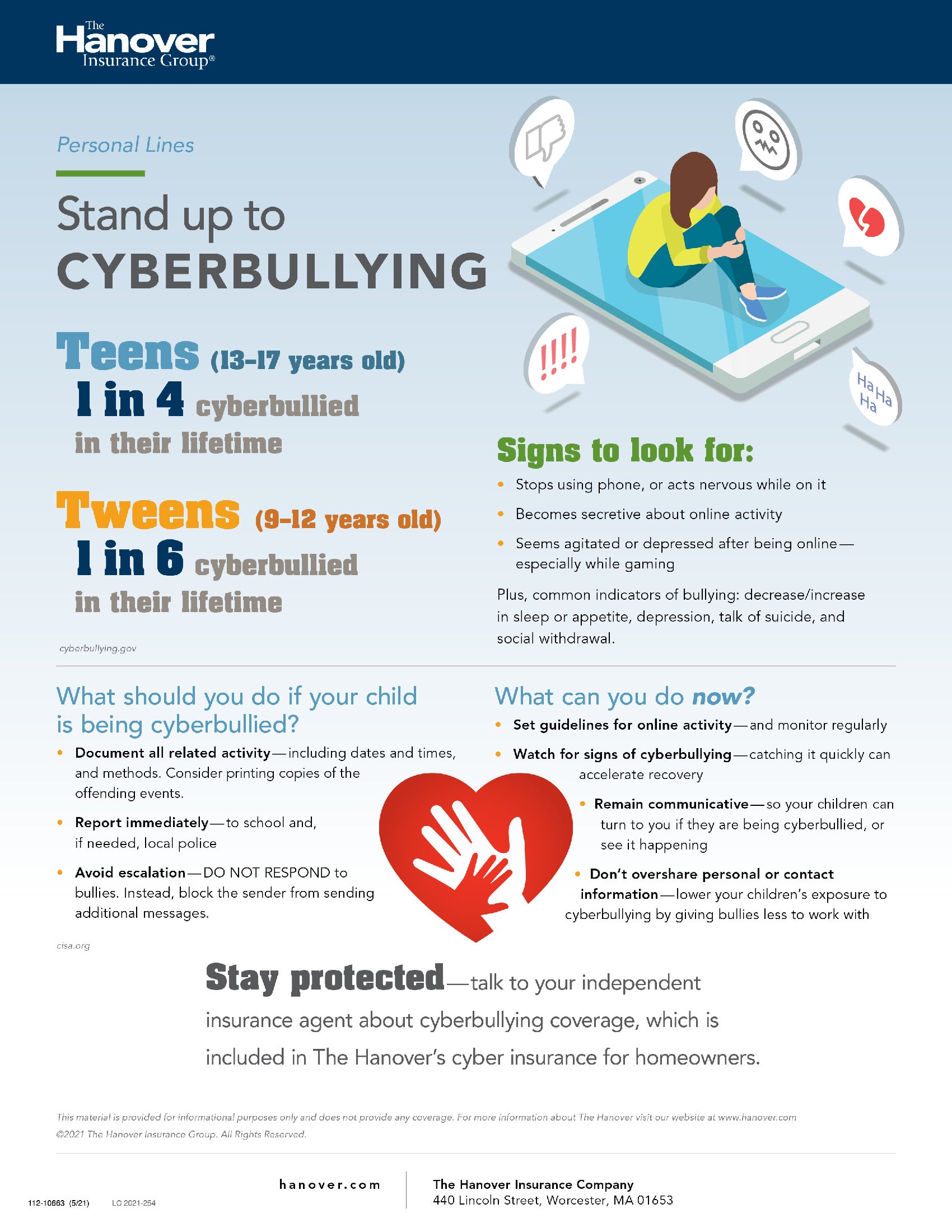
Stand up to cyberbullying

Cyberbullying stats infographic

Stopbullying.gov defines cyberbullying as sending, posting, or sharing negative, harmful, false, or mean content about someone else using digital devices like cell phones, computers, and tablets. Talk to your independent insurance agent to see how The Hanover's cyber coverage for homeowners can help you and the ones you love stand up to cyberbullying.


The recommendation(s), advice and contents of this material are provided for informational purposes only and do not purport to address every possible legal obligation, hazard, code violation, loss potential or exception to good practice. The Hanover Insurance Company and its affiliates and subsidiaries (“The Hanover”) specifically disclaim any warranty or representation that acceptance of any recommendations or advice contained herein will make any premises, property or operation safe or in compliance with any law or regulation. Under no circumstances should this material or your acceptance of any recommendations or advice contained herein be construed as establishing the existence or availability of any insurance coverage with The Hanover. By providing this information to you, The Hanover does not assume (and specifically disclaims) any duty, undertaking or responsibility to you. The decision to accept or implement any recommendation(s) or advice contained in this material must be made by you.

LC 2021-254

Video

The answers to all your questions about cyber insurance for homeowners

We get it - understanding how to best protect yourself online can be confusing. That's why The Hanover believes that cyber protection begins at home. See what The Hanover's cyber coverage for homeowners does and why it's so important to have it.
 

What is cyber insurance for homeowners?

Our home cyber protection aids you with recovery and related expenses resulting from a cyberattack, data breach, online fraud, cyber extortion or cyberbullying event affecting you or family members on your policy.

Additionally, this coverage applies to cell phones, tablets, and any smart device connected to your account. This includes, and is not limited to, wearables, thermostats, entertainment systems, home security devices, smart appliances and much more.
 

How does cyber insurance differ from cyber protection from a third-party (e.g. Lifelock)? Or the cyber coverage I have on my current home policy?

The main difference is that third-party cyber security vendors provide support and direction, but don't reimburse costs related to recovering from a breach or hack. The Hanover partners with CyberScout to offer these types of cyber protection services. But, with our home cyber protection coverage, you benefit from these services and reimbursement in the wake of a covered cyber event for costs you incur in the recovery process. 
 

Does cyber insurance for homeowners apply if I run a business out of my home? Or if I work from home?

This coverage only applies to cyber incidents and losses of a personal nature, and not associated with your work or a business you operate. For business owners, Hanover home business solutions offers a suite of packages that can be chosen a la carte, based on the nature of your business.
 

Do I need to be a Hanover home insurance customer to add this coverage?

Yes. Also consider that having all of your personal insurance needs with one company can translate into cost savings for you, and the convenience of just one bill to pay and one number in the event of a claim. The Hanover offers coverage add-ons (called "endorsements") for watercraft, motorcycles, specific valuable items such as art collections or wine cellars, and much more. Talk to your agent to see how The Hanover can provide a one-company solution for your personal insurance needs, or find an agent near you
 

What is cyberbullying?

Stopbullying.gov defines cyberbullying as sending, posting, or sharing negative, harmful, false, or mean content about someone else using digital devices like cell phones, computers, and tablets. Cyberbullying can affect people of any age, but teens tend to bear the brunt of it. In fact, the Centers for Disease Control and Prevention reports that roughly 1 in 6 high school students experienced cyberbullying within the last 12 months.

For the purposes of our coverage, cyberbullying is defined as:

Two or more similar or related acts of...

  • Harassment
  • Intimidation
  • Defamation
  • Invasion of privacy
  • Threats of violence

...that are carried out using...

  • Computers
  • Cell phones
  • Tablets
  • Similar smart devices


The Hanover's cyber coverage for homeowners protects against expenses related to a cyberbullying event, including temporary private tutoring and relocation to an alternate school. 


How much does cyber insurance usually cost?

There are many different factors that can affect the cost of our cyber insurance for homeowners, including the fact that we offer coverage options ranging up to $100,000 in protection. But no matter how much you need, you will likely find our cyber coverage affordable, as well as valuable. Contact your local independent agent for a quote on a homeowners insurance policy that includes this important coverage.
 

Additional questions?

Talk to your independent insurance agent about your options for cyber coverage for your home. You can also find additional details on our cyber coverage for homeowners page.


Find an agent


All products are underwritten by The Hanover Insurance Company or one of its insurance company subsidiaries or affiliates (“The Hanover”). Coverage may not be available in all jurisdictions and is subject to the company underwriting guidelines and the issued policy. This material is provided for informational purposes only and does not provide any coverage. Visit our website, hanover.com, for more information about The Hanover.     

LC 2021-235

Article

Why you need boat insurance

Hitting the open waters for the first time in your new boat is a thrill, but insuring that purchase is an important step in making sure your new investment is protected.

Understanding your watercraft insurance options now will help make sure you don’t get seasick later in the event of an incident.


If you still have questions, ask an independent agent about how watercraft insurance can help you and fit your lifestyle.


Why do I need insurance for my watercraft?

Although boat insurance is not required by some states, banks often will require you to have insurance in order to finance your boat purchase. Many ports and marinas also require insurance if you want to use their facilities.

Without the liability protection that comes with adequate boating insurance, you could be on the hook to pay substantial costs, in the event of an accident with one of the more than 11.8 million other recreational vehicles out on the water.

Do boating accidents happen frequently?

In 2019, the Coast Guard reported 4,168 boating accidents - a figure that has remained consistent year to year - that lead to $55 million of property damage resulting from recreational boating. From those accidents, there were 2,559 injuries - representing more than 61 percent of those accidents - and 613 deaths.

Are there uninsured/underinsured boats on the water?

Yes. Because boating insurance is not required by most states, if you don't have additional coverage you can be on the hook for damages or the costs of injuries that another boater causes. Some insurance companies, including The Hanover, offer uninsured/underinsured coverage to help you or another rider on your boat in the event of an incident with another boater with inadequate insurance to cover damages. with no or less insurance than what is needed.

What factors can impact my boat insurance rate?

In general, the size, type and age of your boat, as well as what state you live in, size of the motor and what body of water you will use it on can all be factors in determining cost.

Does boat insurance include all my stuff on the boat?

With The Hanover, you have the opportunity to customize your policy to cover your personal items and things like fishing equipment up to a certain agreed upon amount. Hanover's base policy includes some coverage for this and gives you the option to increase this amount.

Are there discounts available for insuring my boat?

Yes. You can save money when your auto, home and watercraft policies are insured with The Hanover. Completing certain safety and education certification courses can also make you eligible for a discount.

Talk with your independent agent to learn more about what you are eligible to save.

Where can I learn more about boating insurance?

Talk to your independent agent for more information about the watercraft insurance that's right for you. The Hanover also has helpful resources to help you start your voyage.

Sources

Safe Boating Council

Insurance Information Institute

Trusted Choice

Value Penguin

All products are underwritten by The Hanover Insurance Company or one of its insurance company subsidiaries or affiliates (“The Hanover”). Coverage may not be available in all jurisdictions and is subject to the company underwriting guidelines and the issued policy. This material is provided for informational purposes only and does not provide any coverage. (For more information visit www.hanover.com.)

LC 2021-186

Subscribe to