Article

How to buy a boat for you

When you want to be on the water, you have choices.

There are plenty of types, styles and sizes of boats that fit all sorts of interests and lifestyles on that water.

Make yourself a checklist of questions to help you determine the boat that best fits your lifestyle within your price range.


Question checklist

  • What will you use it for? Functionality is important. Determine if you plan to use your boat for fishing, watersports, sailing or just simply cruising up and down the water. In addition, knowing if you plan to use it in saltwater versus fresh water can help focus your choice.
  • How many are coming aboard? If you plan to have a cozy experience with only a few passengers, smaller crafts will work best. Looking to play lake tour guide to more than a dozen, you may need a pontoon or motor yacht to accommodate your larger group. Make sure to ask about safety features and consider when a boat may be too big for you to manage or handle.
  • What engine are you interested in? There are inboard, outboard, jet propulsion and more styles of engine – as well as the simple sail if you are looking for a quieter ride. If your engine style matters to you, make note of it before browsing.
  • Where will it dock? Whether you plan to dock at a marina or trailer it around, your answer can help determine if you need to consider any limitations a certain boat may have. For instance, if you are towing the boat, how are you able to get it to the water? If you plan on keeping the boat at a marina, find out if you have enough space to keep it there and safely maneuver in and out of it. Consider year-round factors, such as where you may turn for boat maintenance and if you are looking to the store your boat for an extended time, such as over the winter months.

Make sure your choice is seaworthy

Now that you have pinpointed what type of boat you want, consider a few more points to help you in making your choice…

  • Price. This can help you determine whether to buy new or used and if you should go up or down in size. If buying used, consider answering a few more questions to make sure the boat is fit for the water – and your needs.
  • Perform a sea trial. Ask to take the boat for a sea trial to determine how it rides. Come with a checklist of items to see how it performs on the water, just like you would when buying a car.
  • Survey the scene. You should consider hiring a surveyor to conduct a marine survey to inspect the boat properly. Ask a surveyor about having it hauled out to see any hidden issues below the water line. Some insurance companies require a survey to insure used boats.

Before purchasing, make sure you have the right insurance protection for your ideal boat. Understand what your insurance options will cover such as uninsured/underinsured liability, towing and assistance, hurricane haul out coverage, pet injury protection, personal effects or fishing equipment coverage and more.

Ask an independent agent about boat insurance – and the coverage options that can help keep your boating plans afloat.


Sources

Boats.com

Discover Boating

This material is provided for informational purposes only and does not provide any coverage or guarantee loss prevention. The examples in this material are provided as hypothetical and for illustration purposes only. The Hanover Insurance Company and its affiliates and subsidiaries (“The Hanover”) specifically disclaim any warranty or representation that acceptance of any recommendations contained herein will make any premises, or operation safe or in compliance with any law or regulation.  By providing this information to you, The Hanover does not assume (and specifically disclaims) any duty, undertaking or responsibility to you.  The decision to accept or implement any recommendation(s) or advice contained in this material must be made by you.

LC 2021-214

Articulate

Hanover International Travel Assist

Articulate

A boatload of insurable watercrafts

Should you consider high-value insurance for your home or auto?

Do you drive a high performance car or live in an area with a high cost of living? Do you have a vacation home or a boat?

You might belong to the group of consumers who need more coverage than a standard home and auto package. With more complex asset protection needs, it's important to have the right coverage in place. 


You might need high value insurance if you:


Drive a high performance car


Own a boat or recreational vehicle


Own more than one home


The precise protection you need

Many insurance carriers have traditional, structured coverage packages, but those with more to protect need refined insurance coverages tailored to their needs.


More than 3 million homes in the US are worth at least $1 million and the number of million-dollar homes nationwide continues to grow.1

That's why we offer Hanover Prestige, a combination of powerful protection, care and service, and flexibility and choice. Prestige is a tailored coverage solution that can be added to a standard coverage package, with higher or lower coverage to address more complex needs.

Powerful protection

  Prestige Auto provides a la carte insurance coverage options for high value cars or luxury cars that can be customized by vehicle, including lifetime original equipment manufacturer parts, rental coverage upgrade up to $6K and full replacement cost for a new car in the event of a total loss

  Prestige Home offers coverage for high value homes, including guaranteed replacement cost with a cash settlement option and coverage for hotels and meals for throughout a loss of use of your home, with no limits. It also includes service line coverage of $20K to cover electrical and plumbing lines to the street.

  Prestige Condo offers protection to condo and co-op owners, for the home and possessions, with limits starting at $250K. With built-in coverage for loss of use, water backup, loss mitigation, personal liability and more, it's versatile, valuable protection.

Care and service

In addition to strong protection, Hanover Prestige provides a level of service above and beyond the standard, including:

Flexibility and choice

What truly sets Hanover Prestige apart is the flexibility and choice in customizing coverage options. You can work with your independent agent to determine the combination of price and protection that's right for you and your needs.

Hanover Prestige is available on auto and/or home policies. It is also available on just one car or on all of your vehicles. Coverages for other structures and contents can be adjusted up or down based on your needs and all Prestige auto coverages can be added a la carte.

Learn more

Interested in learning more? Contact your independent agent to see if Hanover Prestige is right for your needs.

Find an agent near you

Sources: 

1 Million-Dollar Creep: Neighborhoods Crossing Over

All products are underwritten by The Hanover Insurance Company or one of its insurance company subsidiaries or affiliates (“The Hanover”). Coverage may not be available in all jurisdictions and is subject to the company underwriting guidelines and the issued policy. This material is provided for informational purposes only and does not provide any coverage.

Article

Oil and gas security controls

As the oil and gas industry goes through cyclical downturns equipment becomes more and more idle. During these idle times it is important for service contractors and oil and gas operators to continue protecting equipment assets. Oilfield equipment storage is expensive and requires additional security measures to minimize losses. Below are property and equipment conservation considerations and techniques to control and mitigate idle equipment losses.

Area assessment  Provide an overall assessment where equipment is stored.

  • High/low crime area?
  • Remote area with little or no traffic?
  • Well-lighted area with high traffic and local police patrols?

Equipment assessment  assess equipment values stored and equipment access from a theft standpoint.

  • Update equipment list and scheduled values stored by item and location.
  • Is larger equipment required to load your equipment?

Security controls  provide on-site security personnel

  • Preferred method of security due to the physical presence of personnel and ability to make immediate calls to police authorities and management.
  • Most oil and gas work sites are remote presenting challenges due to low traffic and unlikely theft detection.

CCTV and other surveillance equipment

  • CCTV cameras preferred when possible; remote locations can be difficult from a logistic standpoint due to internet availability  cameras are recommended when/where possible.
  • Onsite fixed motion-sensing surveillance technology can also be deployed to alert police authorities and management.

Equipment arrangement

  • Equipment placement can be an effective theft deterrent.
  • Techniques include blocking lease roads with heavy equipment, setting up perimeter with larger heavier equipment and storing smaller items in the center of the perimeter, etc.

Power sources

  • Removing keys from stored or parked mobile equipment is recommended.
  • Install hidden battery disconnect switches to isolate power from batteries to equipment’s engine starters.
  • In some instances, removing equipment batteries can be preferred.

GPS asset tracking

  • Recommended whether equipment is stored in low, moderate or high theft potential areas.
  • Asset tracking has become more affordable  alerts can be sent to user mobile devices in real time when equipment is moved.
  • Equipment can be tracked and recovered in an efficient manner ― local police authorities are more likely to assist in recovery of equipment provided with GPS tracking software due to efficiency and high recovery rates.

Oil and gas equipment security best practices

Drilling rigs

  • Surveillance personnel are recommended to monitor short duration stack outs and stacked drilling rigs set in remote oil and gas sites for extended time periods (up to a year).
  • Deploy mobile trailer setups or drilling rig pusher shacks for surveillance/watch person quarters with portable electric generators or public utility power supply if available.

Workover rigs

  • During idle times store workover rigs in headquarter yards as these rigs are mobile with minimum ancillary loads.
  • In cases where workover rigs are left overnight during well service operations bring power tongs and other expensive ancillary equipment back to secured yards each night.
  • Service trucks used for work crew transport to/from worksites can carry power tongs and other smaller expensive equipment to storage yards and warehouses.
  • Locks on doghouses are easily knocked off with a hammer and provide no real hurdle for thieves.

Generators, air compressors, iron, and other equipment used on completion/production jobs

  • Materials and equipment can be difficult to move back and forth each evening after a day’s activities.
  • Perform an onsite evaluation to determine if a night watch person is needed.
  • Ongoing services such as frack jobs are typically ongoing and personnel are onsite 24/7 during these operations.

Lay-flat hose, aluminum piping and pumps

  • Two types of service contractors providing lay-flat hose and piping are those renting the hose/pipe out to the customer and leave it in the field for extended stays without daily supervision; and service contractors sending work crews to jobsites and provide water logistics throughout well servicing operations.
  • Monitoring and tracking lay-flat hose, aluminum piping and pump rental operations is challenging when oilfield contractors often rely on their customer to manage whereabouts and upkeep.
  • Daily inspections to verify lay-flat hose, aluminum piping, and pumps are secured.

Equipment schedules

  • Periodically update equipment schedules and valuations to agent with the distinction between “active” and “stacked” equipment.
  • Inventory equipment by assigned locations as needed to maintain asset accountability.

Hot work

  • Refrain from hot work activities where large concentrations of equipment are stored in proximity.
  • Assess environmental factors and adequately separate equipment prior to hot work activities when performing upgrades to idle/stacked drilling rigs, workover rigs, and other equipment.
  • Implement hot work procedures and controls, including a fire watch person.

Contractual risk transfer (CRT)

  • When equipment is moved to/from work sites and storage yards by third party trucking companies, properly screen trucking companies to ensure adequate contractual risk transfer (CRT) agreements are in place.
  • Written contract agreements should be reviewed by legal counsel at least annually to ensure appropriate risk transfer language and limits of insurance are in place.


This material is provided for informational purposes only and does not provide any coverage or guarantee loss prevention. The examples in this material are provided as hypothetical and for illustration purposes only. The Hanover Insurance Company and its affiliates and subsidiaries (“The Hanover”) specifically disclaim any warranty or representation that acceptance of any recommendations contained herein will make any premises, or operation safe or in compliance with any law or regulation. By providing this information to you, The Hanover does not assume (and specifically disclaims) any duty, undertaking or responsibility to you. The decision to accept or implement any recommendation(s) or advice contained in this material must be made by you.

LC 2020-170

Article

Salt water disposal guidelines

.

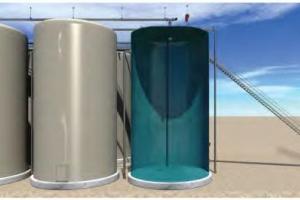
Static drain interior or tank one
Tank battery―disposal well. Photo courtesy Petro Guardian.

Introduction

Each year tank batteries and other production equipment used in the oilfield are damaged due to lightning strikes and static electricity encounters. Salt water disposal (SWD) sites present a challenge due to tank battery exposures and the flammable fluids/vapors held within the tanks.
Holding tanks utilized with SWD’s include both metal and fiberglass tanks. Metal tanks, if sitting flat on the ground, are at times adequate for grounding dissipation; however, a qualified professional is needed to determine if ground moisture levels provide continuity.
Various tank manufactures have incorporated bonding/grounding materials within fiberglass tanks; yet this alone is not sufficient and additional bonding/grounding controls for static electricity are needed within tanks for storing/transferring large volumes of oilfield fluids.


Lightning protection

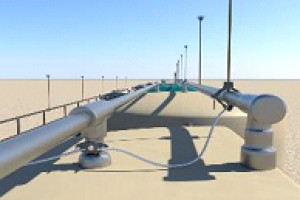
Aerial static dissipators

Preferred method of lightning protection. This design type involves structural static dissipators positioned above the tanks and along catwalks to control static electricity near/around the tank battery immediate area. Typically, lightning does not find this atmosphere attractive for a strike.

Salt water disposal well controls photo 2.jpg
Static dissipators―lightning protection. Photo courtesy Petro Guardian.


Salt water disposal Well controls Photo 3.png
Static dissipators―lightning protection. Photo courtesy Petro Guardian


Catenary lightning protection

Accepted if properly installed and grounded. This lightning protection design “is old style” consisting of a bonded-grounded conductor rod mounted to the top of a pole, which is typically routed around the perimeter of the site being protected. The theory is if lightning were to hit, it would hit the lightning rod and dissipate through the ground system. Overhead bonding lines should be elevated high enough out of the tank’s vapor space per industry best practices.

Static control

Static drain interior of tank two
Static drain lasso―inside view of fiberglass tank. Photo courtesy Petro Guardian.

Static lassos

Preferred method of static electricity protection. Installed within the interior of a tank, these lassos dissipate static electricity build up from within a tank holding oilfield fluids. As fluids move around within tanks, static electricity occurs and can be an ignition source for the vapor space.   Static lassos should be properly bonded and grounded.

Thief Hatch for Lightning page.jpg
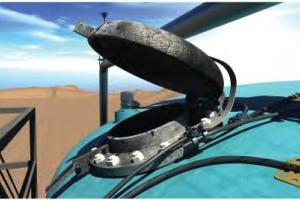
Thief hatch (bonding/grounding)―top view of fiberglass tank. Photo courtesy Petro Guardian.


Thief hatches

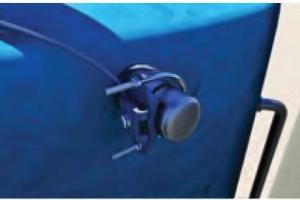
Bonding wire/cable provided from lid to base and bonded back to properly grounded trunk line. Thief hatches are a vapor explosion hazard due to vapor presence and arc possibility; as the thief is located at the top of the tank along with potential flammable vapors. Thief hatch lids must be bonded/grounded as illustrated below.

Metal Fitting Fiberglass Tank (bonding and grounding) for Lightning page.png_.jpg
Metal bull plug (bonding/grounding)―top view of fiberglass tank


Metal piping/valves/fitting

Metal objects extending from fiberglass tanks must be bonded and grounded.


Truck trailer loadout bonding-grounding
Truck load-out with static bonding. Photo Courtesy of Petro Guardian.


Load out stations

Trucks/Trailers offloading oilfield fluids must be bonded to an adequate ground source.


Maintenance and inspection

Documented electrical bonding and grounding systems inspections should be completed every six months and include repairs or maintenance items needed and performed.


This material is provided for informational purposes only and does not provide any coverage or guarantee loss prevention. The examples in this material are provided as hypothetical and for illustration purposes only. The Hanover Insurance Company and its affiliates and subsidiaries (“The Hanover”) specifically disclaim any warranty or representation that acceptance of any recommendations contained herein will make any premises, or operation safe or in compliance with any law or regulation. By providing this information to you, The Hanover does not assume (and specifically disclaims) any duty, undertaking or responsibility to you. The decision to accept or implement any recommendation(s) or advice contained in this material must be made by you.

LC 2020-390

Article

The answers to all your questions about motorcycle insurance

Americans bought 468,000 motorcycles in 2019 alone. Joining the millions of other vehicles on the roadways – motorcyclists have a lot of obstacles on the road.

Where to start when it comes to motorcycle insurance can be a common roadblock off the bike.

Stay safe and give yourself peace of mind with a motorcycle policy – and what it can do for you.


Do I need motorcycle insurance?

Motorcycle crashes run up direct costs into the billions of dollars every year between medical costs, lost wages, property damage, hiring defense lawyers and claims filed.

Also, motorcycle insurance is required in every state except for Florida.

What does the typical motorcycle insurance policy cover?

Policies vary from insurance company to insurance company. Typically, a basic motorcycle insurance policy will have some form of coverage for:

  • Liability: injury/damage done to others
  • Collision: damage to your motorcycle
  • Comprehensive: theft or damage to the bike from something other than a collision, such as a fire
  • Uninsured/underinsured motorist: injury/damage to you and/or your property if other drivers involved have insufficient coverage

What options do I have for extra insurance protection?

There are many choices out there to personalize your coverage to your riding lifestyle. Some insurance companies like The Hanover offer the chance to purchase additional enhanced coverage that may cover things like:

  • Custom and chrome parts
  • Roadside assistance
  • Trip interruption
  • Personal effects
  • Accident forgiveness

Plus, you may be eligible for discounts and savings by bundling your bike with your home and auto, taking a safety course, or being a part of a rider group. Talking to an independent agent can help sort out what options are available – and what coverage makes sense for you.

What type of motorcycles does insurance cover?

Many insurance companies cover some range of motorized bikes approved for highway use. The Hanover has a broad range of bike styles eligible for coverage, such as:

  • Traditional
  • Cruiser and chopper
  • Scooter
  • Touring
  • Sport and trikes
  • Enduro

An independent agent can help you answer questions about specific rides you may have in mind.

How can you find out more about insuring your motorcycle?

Talk to an independent agent about the motorcycle coverage that's right for you and how you ride.


Find an agent


Sources:

Insurance Information Institute

Insurance Information Institute

LC 2021-133

Article

Top 6 motorcycle safety tips

A motorcycle ride on the open road – there are few driving experiences like it.

As thrilling as that sunny ride down a wide-open road feels, motorcyclists must take more precautions than other drivers. 

Whether you are a new or experienced rider, observing these six safety tips can help you avoid serious injury.


1. Take the class

All new riders should take a motorcycle safety course, but don’t slam the brakes on motorcycle education once the initial class is passed.

Experienced riders should also consider taking refresher courses from time to time to stay sharp. Plus, you may be eligible for an insurance discount by completing a safety course.

2. Buy the right helmet…and wear it

The National Highway Traffic Safety Administration estimates that helmets saved the lives of 1,872 motorcyclists in 2017.

Not all states have helmet laws. The ones that do have such laws see a reduction in serious and fatal injuries. State mandate or not, wearing a helmet can help reduce injury.

Additionally, make sure your helmet is DOT-compliant, which meets established safety standards required by law to best protect your head.

3. Gear up even more

Dress the part so you and others on the road can see everything clearly.

Wear bright or reflective clothing, especially if you plan to use your motorcycle at night. Wear clothes that are durable and boots that cover your ankles.

Make sure all glasses/goggles/face shields are well ventilated to prevent them from fogging on the road to avoid other vehicles and clearly spot potholes, puddles, railroad tracks and other roadway obstacles.

4. Prioritize anti-lock brakes

The ability to brake confidently on a motorcycle is vital – and more complicated.

With separate front and rear brakes, using them too fast can lock one or both of the wheels and overturn the motorcycle. A motorcycle equipped with an anti-lock brake system (ABS) significantly reduces a driver’s crash rate.

If you’re in the market for a new ride, an ABS should be near the top of your shopping list.

5. Don’t speed or drink

Speeding and drinking alcohol prior to jumping on a motorcycle are common factors in serious and fatal accidents.

According to a 2018 National Highway Traffic Safety Administration report, 31% of all motorcycle riders involved in fatal crashes were speeding, compared to 18 percent for passenger car drivers, 14 percent for light-truck drivers, and 7 percent for large-truck drivers.

Motorcyclists have a significantly higher rate of serious injury when drinking.

6. Encourage passenger safety

Motorcycle passengers should sit as far forward as possible and keep their feet on foot rests at all times – even when the vehicle is at a stop.

Make sure your passenger knows to minimize movement and only lean at the same time and in the same direction as you. Give your passenger the all clear when it is safe to get off the motorcycle.

Observing these tips can help keep you hit that sunny, open road safely.

To protect you and your motorcycle in the event of an accident, talk to your independent agent today about how The Hanover can help.


Sources

National Highway Traffic Safety Administration

Insurance Institute for Highway Safety

National Safety Council

Insurance Information Institute


This material is provided for informational purposes only and does not provide any coverage or guarantee loss prevention. The examples in this material are provided as hypothetical and for illustration purposes only. The Hanover Insurance Company and its affiliates and subsidiaries (“The Hanover”) specifically disclaim any warranty or representation that acceptance of any recommendations contained herein will make any premises, or operation safe or in compliance with any law or regulation.  By providing this information to you, The Hanover does not assume (and specifically disclaims) any duty, undertaking or responsibility to you.  The decision to accept or implement any recommendation(s) or advice contained in this material must be made by you.

LC 2021-135

Article

Tips to prepare for a long weekend motorcycle trip

It’s 5 p.m. on Friday, and there is nothing between you and that long weekend motorcycle trip – almost nothing, that is.

You still have to pack essentials for an entire weekend onto your bike. When traveling over a long distance, planning ahead can be the difference between time hugging the road and time troubleshooting a problem from the side of it.

Bike check, 1-2-3

Adjust your suspension accordingly if you plan on carrying more luggage than you normally take, especially if you will be riding with someone else. If you are bringing more luggage along, you may want to consider increasing your motorcycle personal effects coverage.

Check out your tires and make sure they are inflated properly and ready for the length of the journey. If you have not had an oil change recently before the trip, do so.

It’s also a good idea to try and pack your motorcycle the night before your trip to make sure everything attaches securely and fits in place.

Stop spots

Mapping out your route may steal some of the “adventure” away from a trip, but it will help ensure you have enough time to enjoy every part of it.

You will need to take breaks eventually. Even if you have driven the route before, make a plan to determine where and when you will need to stop for bathroom breaks, gas fill ups, eat and even take a quick power nap to regain some of your energy.

Packing a GPS – or cell phone with GPS capabilities – can help keep you on time and on track to see everything you want to see.

New terrain, new challenges

Are you in it for a long haul to somewhere new? Brush up on weather and local laws.

Consider the weather in the regions you are traveling to if you need to dress in layers – or if there is an impending storm you may need to find temporary shelter from during the trip.

Trip interruption coverage can reimburse you up $600 for necessary expenses if you are more than 100 miles away from home and the motorcycle is damaged too much to be driven. These expenses include food and lodging, travel expenses and the cost to return the motorcycle home.

Also, while your state may not require a helmet by law, the one you are traveling to might. Wear your helmet at all times to stay safe – and legal.

Tire rehab

Few things will deflate faster than your weekend plans as a tire issue on your motorcycle.

Packing a pump and repair kit can help patch up and pump up potential problems – and most of these pieces of equipment are small enough to not take up precious real estate in your pack.

Road assistance

You’ve hit that open road with nothing but pavement and the great outdoors around you. In the event you need help, make sure you have a lifeline.

Tell someone of where you are going in case you need help. In addition to a charged cell phone, consider a motorcycle policy that has an option for roadside assistance. Talk to an independent agent for more information on roadside assistance coverage.

Plan the next long trip now

Once that bike hits your garage and the trip is over, take stock of all the stuff you packed.

Bring clothes, gear, extra food or other things you didn’t need? Make a note of what ended up being dead weight so you can ride leaner without it the next time.


The open road is calling. With a plan for that long weekend trip, you can make the most of your time to do what you came to do – enjoy the ride.

If you want to maximize your coverage options and have extra peace of mind, plan to talk to your independent agent to ensure you have a motorcycle policy that fits your lifestyle.


Sources

RevZilla

Motorcyclist


This material is provided for informational purposes only and does not provide any coverage or guarantee loss prevention. The examples in this material are provided as hypothetical and for illustration purposes only. The Hanover Insurance Company and its affiliates and subsidiaries (“The Hanover”) specifically disclaim any warranty or representation that acceptance of any recommendations contained herein will make any premises, or operation safe or in compliance with any law or regulation.  By providing this information to you, The Hanover does not assume (and specifically disclaims) any duty, undertaking or responsibility to you.  The decision to accept or implement any recommendation(s) or advice contained in this material must be made by you.

LC 2021-134

Article

The answers to all your questions about high-value home and auto insurance

We have answers to frequently asked questions about insurance coverage for your high performance car or high-end home.

Offering more than your basic home and auto insurance, high-end insurance offers more protection for your home and auto, helping to secure the lifestyle you've worked hard to achieve.

The Hanover offers high-value home and auto insurance to clients through Hanover Prestige. The protection we offer with Prestige is backed by service and expertise that lives up to high expectations. Prestige also offers you the flexibility to tailor the plan to help fit your needs, without paying for unneeded coverage.

For more information, contact your independent agent.

Jump to: Home | Auto | General

What is considered a high-value home?

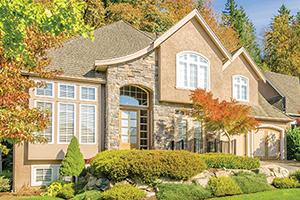
To insurers, a high-value home is a residential house or condo that has a replacement cost of at least $750K.
 

What is high-value home insurance?

High-value home insurance is designed specifically for houses and condos with a value higher than the average home, with tailored coverages to meet the different needs of these customers. The Hanover offers Prestige coverage for homes worth $750K or more.
 

How is high-value home insurance different from regular home insurance?

A standard homeowners insurance policy insures the structure of your home, your belongings, liability coverage, and sometimes outbuildings such as a shed or garage. Because high-value houses and condos often have more complex needs and valuable belongings, high-value home insurance offers added protection for upscale homes with more flexibility for personal belongings and valuable items, as well as more personal service and care.

Hanover Prestige offers high-value home coverage that provides flexible and broad protection for high-value homes. Beyond coverage, Hanover Prestige also offers access to high-quality service providers, a dedicated claims team and enhanced, personalized customer service for our clients.
 

Do I need a high-value home insurance policy?

Your independent insurance agent will help you determine if your home or auto qualifies for high-value coverage. With The Hanover, Prestige coverage can be added to existing policies for comprehensive property coverage.
 

What’s included in high-value homeowners insurance?

High-value or luxury home insurance often includes expanded coverages and higher limits than your typical homeowners insurance policy, as well as valuable services and flexibility you may not get with a standard policy.

Some of the Hanover Prestige Home coverages include:

  • Loss mitigation coverage – to purchase/install devices to protect against future losses of the same type
  • Loss of use – coverage for hotels and meals for throughout a loss of use of your home, with no limits
  • Service line - higher coverage for excavation and repair of underground wiring, piping and more
  • Guaranteed replacement cost plus – either rebuild or cash out in the event of a total home loss
  • Luxury items – higher limits to replace jewelry, watches and furs

What is a high-value vehicle?

A vehicle is considered to be high value if it requires a greater level of coverage and higher limits than an average auto policy. This can include:

  • Luxury cars with a higher cost of replacement
  • Vehicles with an increased risk of theft
  • Vehicles with sophisticated technology and expensive repair costs
  • High-performance vehicles
  • Antique or classic cars

What is high-value auto insurance?

High-value auto insurance offers expanded coverage for luxury cars or high-value vehicles that require added protection. The Hanover offers Prestige coverage to policyholders with liability limits starting at $250K/$500K or combined single limit liability of $500K.
 

How is high-value auto insurance different from regular auto insurance?

A standard auto policy usually covers collision and liability. High-value auto insurance offers added protection for higher-value vehicles, as well as a higher level of service. These vehicles are typically protected on an agreed value basis, regardless of market depreciation.

Hanover Prestige provides flexible and broad coverage for high-value autos, with added features including a dedicated claims team, personalized client service and flexibility of coverage.
 

What’s included in high-value auto insurance?

High-value auto insurance often includes expanded coverages and higher limits than your standard auto insurance policy, as well as a la carte coverage options for your vehicle. Many high-performance auto insurance policies include an agreed value, meaning you’ll receive the insured value without depreciation in the event of a loss.

Some of the Hanover Prestige Auto coverages that are available a la carte include:

  • Global rental – worldwide protection when involved in an accident with a rental car.
  • Lifetime original equipment manufacturer (OEM) parts - receive the brand name OEM parts, regardless of how old your vehicle is.
  • New car extender - Cars within the three latest model years (up to 45K miles) will get the full replacement cost for a new car in the event of a total loss
  • Repair shop flexibility – use the shop, dealer or mechanic of your choice in the event of a claim
  • Single limit rental reimbursement - up to $6K in rental car coverage without a daily limit
  • Travel companion - Coverage for emergency roadside services, towing up to 100 miles, $1,000 for trip interruption, and $2,500 for pet injury protection.

How much does high-value insurance cost?

When it comes to protecting higher-value homes and autos, you want to make sure you have the right coverage – without paying for coverage you may not need. With Hanover Prestige, coverage can be selected a la carte to provide comprehensive protection for your unique homes and autos.

Your independent insurance agent will work with you to tailor the coverage that is right for your needs, to ensure you get the right combination of value and protection.
 

How do I get insurance for my high-value home or auto?

Contact your independent insurance agent to start a conversation about your insurance needs.
 

Who insures high-value property?

The Hanover offers Prestige coverage designed specifically for high-value homes and autos.

Talk to your independent insurance agent to find upscale home and auto coverage that meets your needs.
 

How can I insure my valuable items?

Most homeowners insurance comes with a limited amount of protection for valuable items. For your most precious items that exceed this limit, a scheduled personal property endorsement or valuable items plus (VIP) property endorsement added to your existing home policy can help make sure your prized possessions are protected. Hanover Prestige offers optional coverage up to $100K for priceless valuables, including fine art and wine.

Your independent agent can help determine what coverage provides you with the best value.
 

Are there additional coverages I may need?

High-net worth households may require additional insurance coverages to meet complex needs, including:

Talk to your independent insurance agent to ensure your prized possessions are protected.

Find an agent near you


Subscribe to